

Random Generator FREE
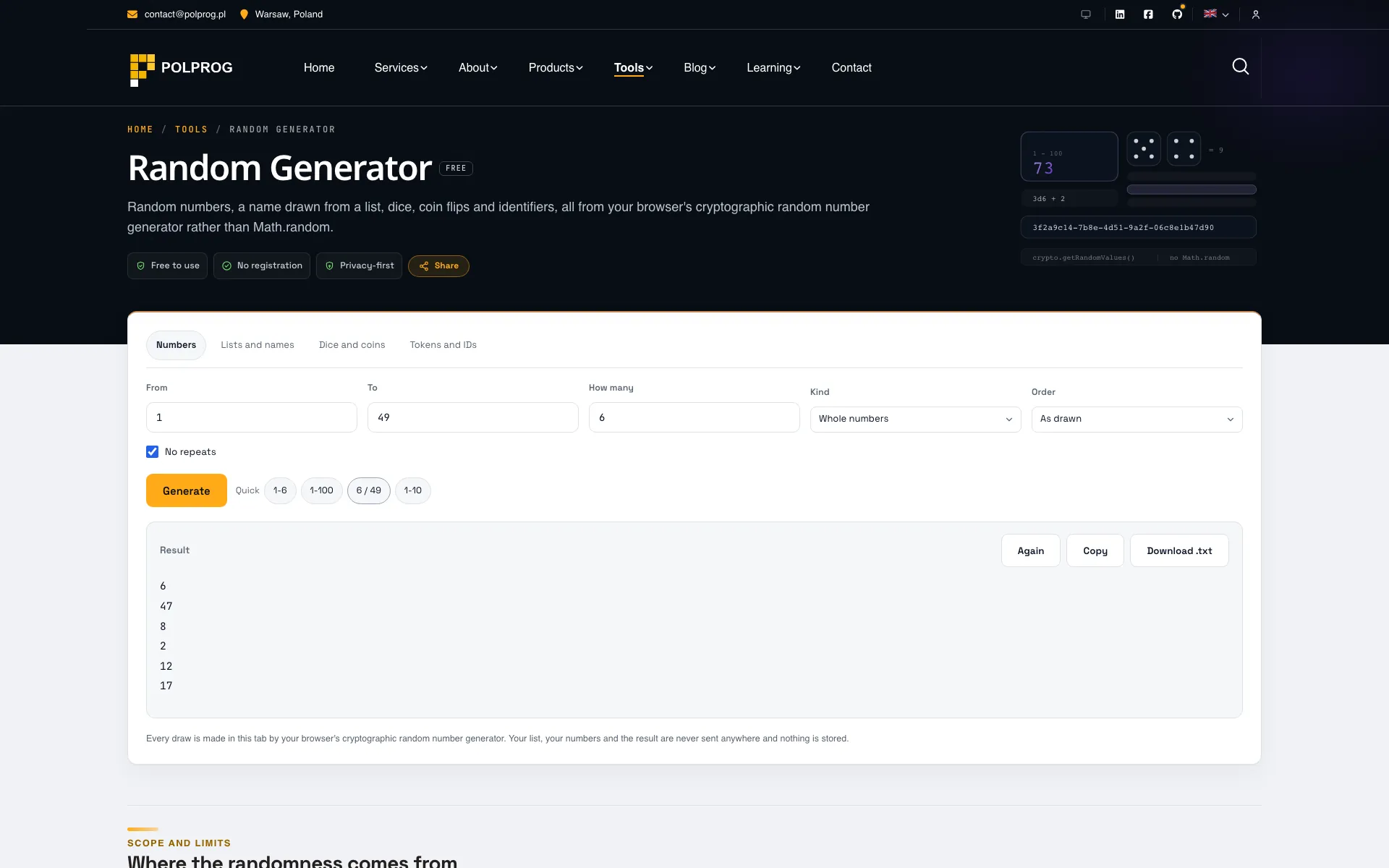
Random numbers, a name drawn from a list, dice, coin flips and identifiers, all from your browser's cryptographic random number generator rather than Math.random.

Numbers
Lists and names
Dice and coins
3d6 rolls three six-sided dice. 2d10+5 adds five to the total. d20 rolls one.
Tokens and IDs
These are identifiers and codes, not passwords. A password you have to copy out of a web page is one your password manager should have made and stored for you.
Result
Every draw is made in this tab by your browser's cryptographic random number generator. Your list, your numbers and the result are never sent anywhere and nothing is stored.
Where the randomness comes from
The browser CSPRNG, not Math.random
Every number, shuffle, roll and identifier is drawn from crypto.getRandomValues, and the values that would make the low end of a range more likely are discarded rather than folded in, so every outcome has the same chance. There is no seed and no way to replay a draw: a result that can be reproduced is a result that can be arranged.
FAQ
Is this random enough for a prize draw?
It uses crypto.getRandomValues, the random number generator your browser exposes for cryptography, rather than Math.random. Math.random is fast and seeded and its future output can be predicted from a handful of past values, which is fine for a game and not fine for anything somebody might contest. Every number, shuffle, roll and identifier here comes from the same source.
Is my list of names sent anywhere?
No. There is no API call behind this page. The list you paste stays in the tab, the draw happens in your browser, and nothing is written to storage: closing the page is all it takes to be rid of it. That matters because a list of entrants is personal data even when it is only first names.
Are the numbers really uniform, or are some more likely?
Uniform. The naive way to get a number in a range is to take a random value modulo the size of the range, and that quietly favours the low end whenever the range does not divide evenly into the source. This tool discards the values that would cause that and draws again, so every outcome has exactly the same chance. The shuffle is Fisher-Yates for the same reason: it is the version that produces every ordering with equal probability.
Can I use it to generate a password?
You can generate a strong random string here, and the tool tells you how many bits of entropy it carries, but a password is better made and stored by a password manager than copied out of a web page. The token panel is meant for API keys, voucher codes, test fixtures and identifiers.
What is the difference between UUID v4 and v7?
A v4 identifier is 122 random bits, so two of them are unrelated and unordered. A v7 identifier starts with the millisecond it was created in and fills the rest with random bits, so v7 identifiers sort by creation time as plain text. That is kinder to a database index, and it also means a v7 identifier reveals when it was made, which is occasionally something you do not want.
Can I get the same result twice?
No, and that is deliberate. There is no seed to set and no way to reproduce a draw, because a generator that can be replayed is a generator whose result somebody can arrange in advance. If you need the outcome on record, copy or download it: that file is the evidence, not the tool.
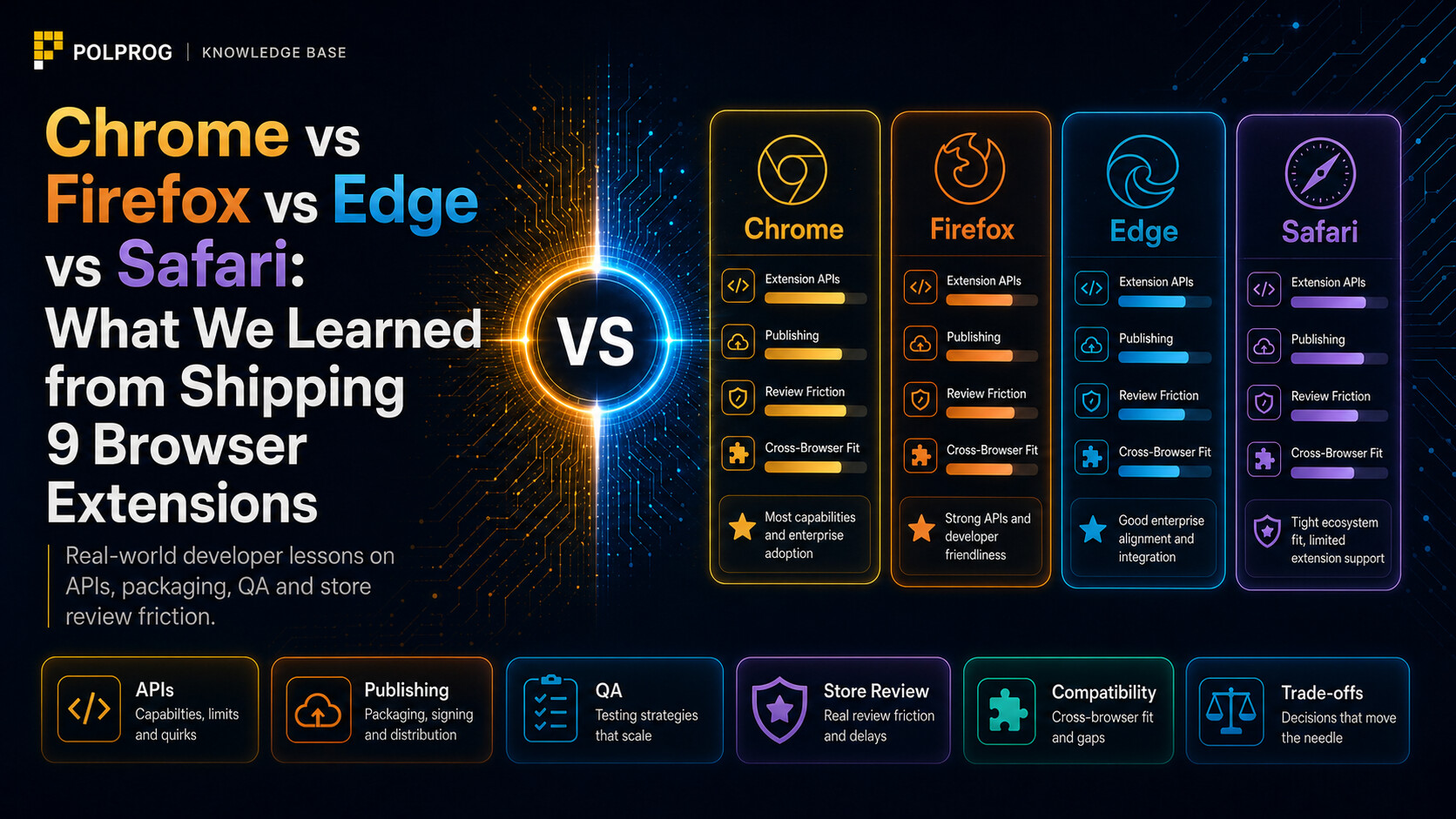
Chrome vs Firefox vs Edge vs Safari: what we learned from shipping 9 browser extensions
Nine extensions, four browsers and far more than one `manifest.json` file. We show where shared code really ends, why Safari needs a separate process and which bugs are exposed only by Firefox and extension stores.
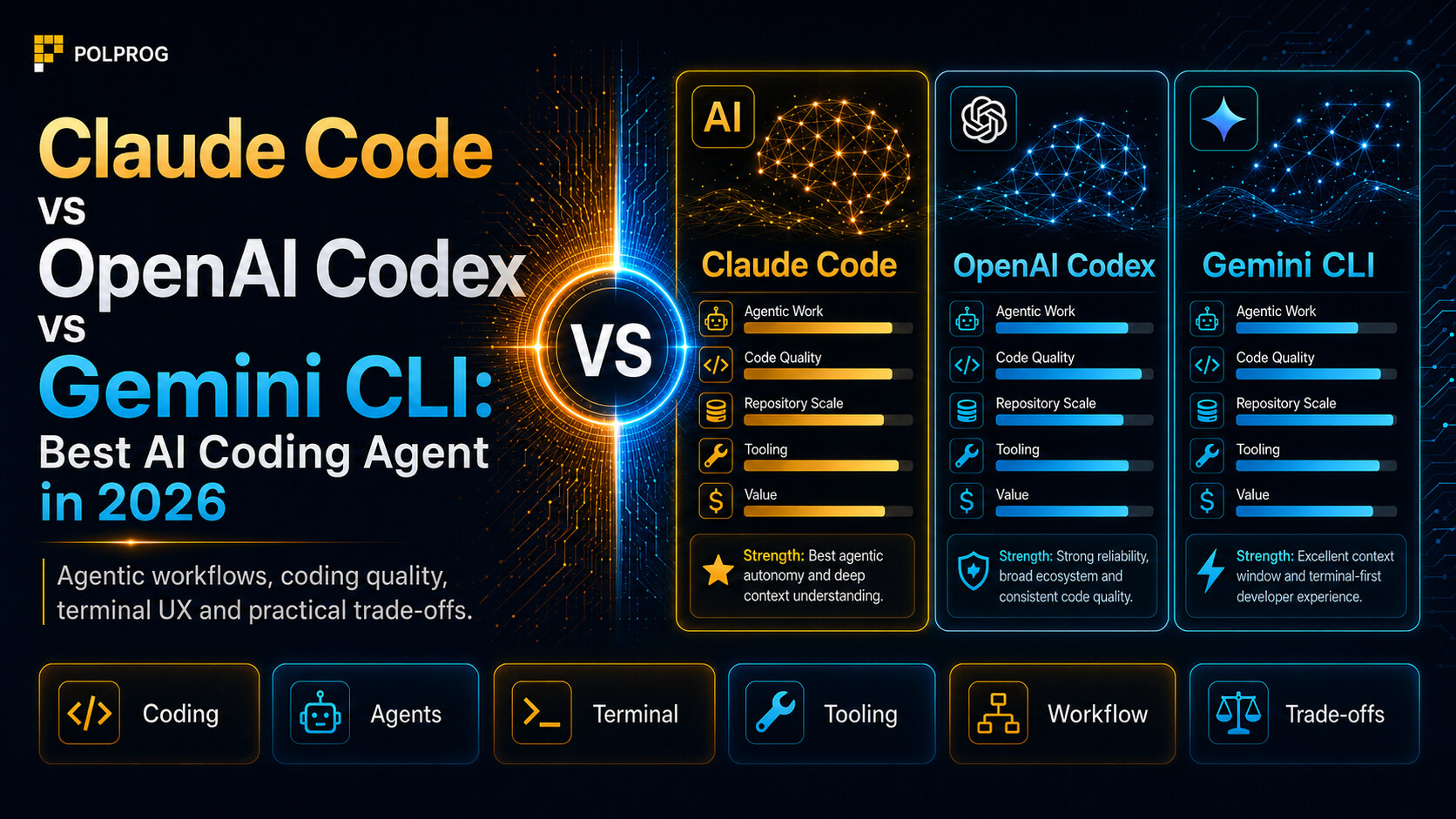
Claude Code vs OpenAI Codex vs Gemini CLI: the best AI coding agent in 2026
Claude Code, OpenAI Codex, and Gemini CLI can read repositories, edit files, and run tests, but they were designed for different styles of work. We compare quality, benchmarks, security, parallel execution, extensions, pricing, and privacy.

How Custom Software Helps Teams Automate Repetitive Work
Not every task should be automated, and not every automation needs a full product. The useful skill is deciding which tasks are worth it, and then building the smallest tool that actually removes them.
Build a better web, faster.
We build custom software and solutions tailored to your needs.