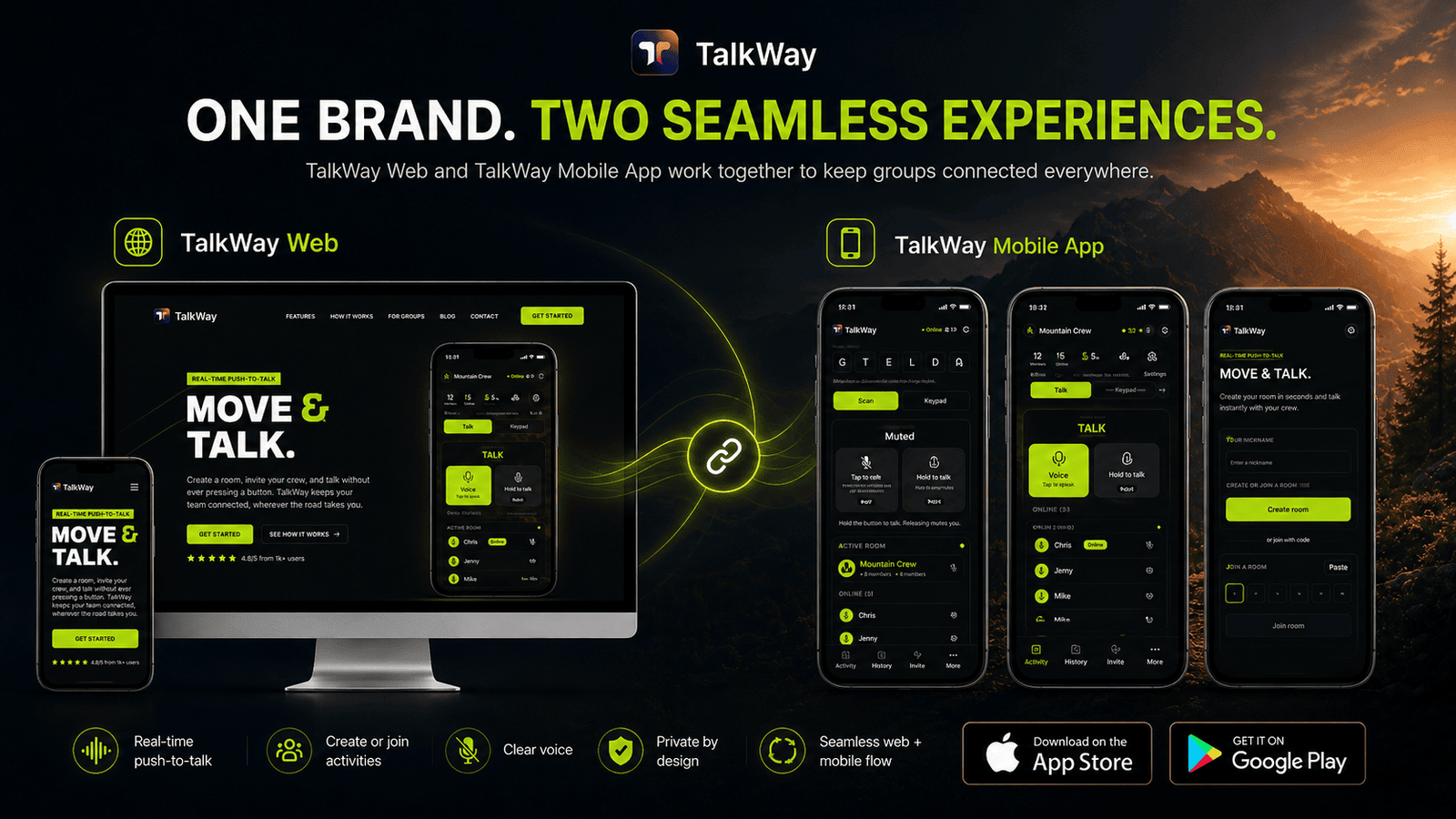
Two products join the portfolio at once and they belong together: TalkWay, a group voice channel for up to five people, and its official site with the product landing, the legal documents and a panel for watching active rooms. The app is already on Google Play.
The idea is deliberately narrow. A group heading out together - on bikes, on a run, in two cars - wants to talk without holding a phone, without a walkie-talkie and without creating an account anywhere. That is the whole product.
TalkWay: five people, one channel
One person creates a room and gets a six-character code. Up to four others join with it and everyone hears everyone. The channel runs over the internet, so unlike a walkie-talkie there is no range to run out of, and unlike a group call there is nothing to answer: either you are in the room or you are not.
Mixed groups were a requirement from the start. Native audio modules were built for both platforms and feed the same session, so once the iOS version lands a mixed room will be the normal case, not a workaround. Once you are in, the phone can go into a pocket with the screen off and the conversation carries on in the background.
What works today, and what does not yet
Two things are worth saying plainly before anyone downloads the app. First, TalkWay is currently available in Poland only - the Android version is on Google Play, the iOS version does not exist yet. Second, the infrastructure serves 75 rooms of five people at a time.
The room limit comes straight from the current server: that is how many parallel sessions the present infrastructure holds. We will raise the ceiling as it grows.
TalkWay does not touch your music
The app plays no music of its own. It runs alongside Spotify, Apple Music or YouTube Music and decides only how the two share your ears: full mix, ducking the music while someone speaks, or voice alone.
There is one limitation worth stating outright, because most voice apps stay quiet about it. A classic Bluetooth headset uses one profile for stereo music and another for two-way voice, and the moment the microphone opens the system switches the link to the poorer mono profile. Music gets quieter and duller and no app can work around it. TalkWay does not pretend otherwise: it asks for a sensible audio route, reports the one it actually got, and shows a clear warning. Open-ear and wired sets have no such switch at all.
Anonymous, and not in the marketing sense
There is no account and no sign-in, so the app never receives a name or an email. Voice is streamed live and never reaches a disk, on the device or on the server. The only thing the backend holds is a short-lived room code that disappears when the conversation ends, which also means there is no profile left to delete.
The permission list has one entry: the microphone. No camera, no location, no contacts.
The official site
talk-way.app does three different jobs at one address: it is the product landing, the full set of legal documents and the operator panel.
The landing explains the product across eight sections - how a room works, how it differs from walkie-talkies and calls, room codes, screenshots from real devices, audio modes, features, the Bluetooth explanation and an FAQ.
What is underneath
Real-time audio runs on LiveKit, with a small backend whose only job is issuing short-lived access tokens. The mobile app is React Native with native audio modules on both platforms. The site is Vite, React and TypeScript.
What is next
Attention moves to the next items on the list. Closest to release is CostBoard, and behind it the rest of the mobile apps in their final stage before launch.
For TalkWay itself the next steps are three: the iOS version, lifting the 75-room limit and going beyond Poland.
The details are on the product pages: TalkWay and the official site.