

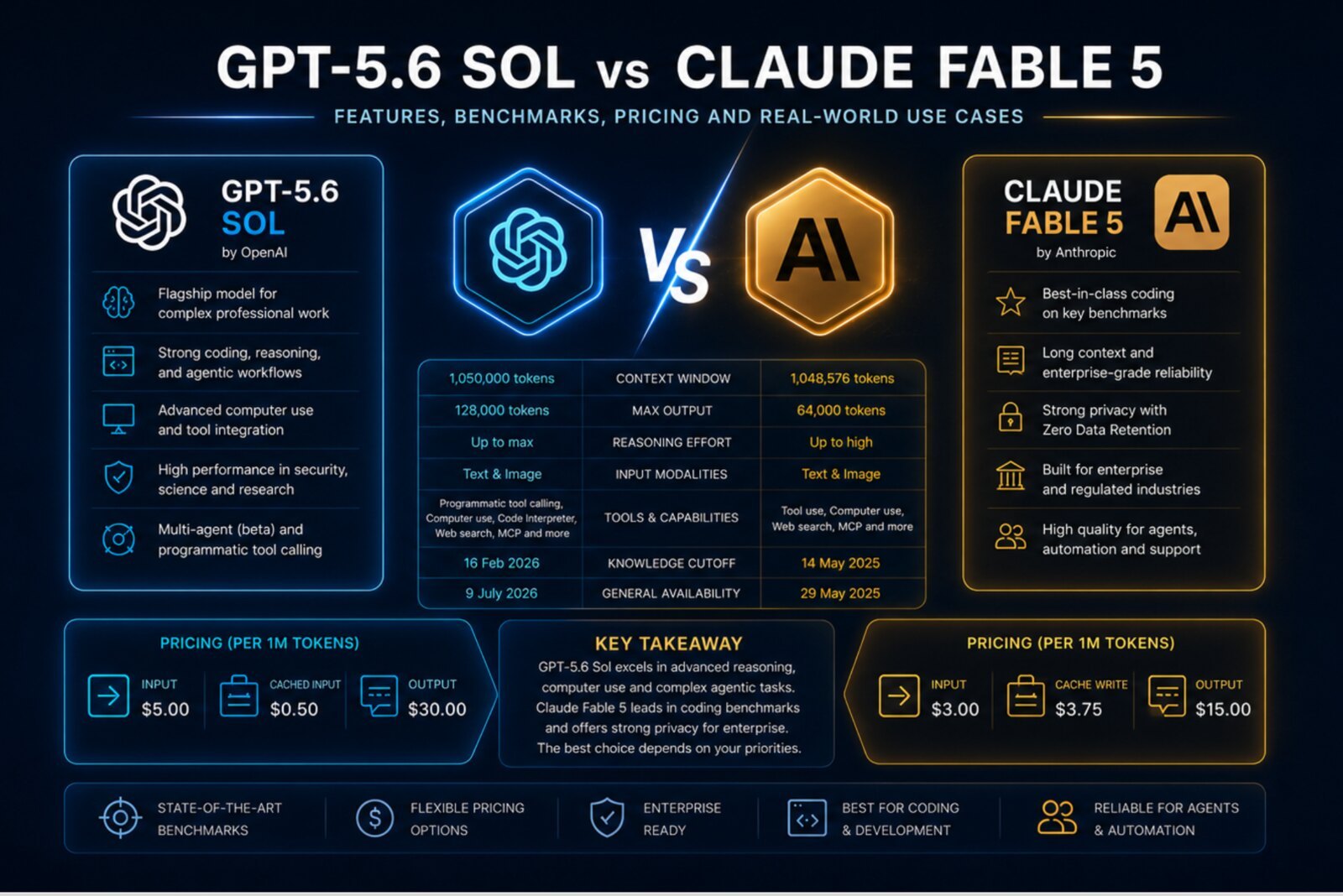

GPT-5.6 Sol and Claude Fable 5 are two of the most capable generally available AI models in 2026. Both are designed for difficult coding, long-running agents, professional knowledge work, visual reasoning and tool-heavy workflows. Both support approximately one million tokens of context and up to 128,000 output tokens. [5][6]
They are not interchangeable.
GPT-5.6 Sol is cheaper under standard short-context API pricing, offers more control over whether and how deeply it reasons, supports OpenAI's Pro and multi-agent workflows, and is eligible for Zero Data Retention for approved API customers. Claude Fable 5 is built around always-on adaptive thinking, is offered across a wider set of major cloud platforms, keeps its standard token rate across the full one-million-token context window and leads several important published evaluations, including SWE-bench Pro.
The benchmark picture is mixed. Sol leads Fable on Agents' Last Exam, the Artificial Analysis Coding Agent Index, DeepSWE, Terminal-Bench, GDP.pdf, GPQA Diamond and AutomationBench in the published comparisons reviewed for this article. [10] Fable leads on SWE-bench Pro, GDPval-AA v2, the Artificial Analysis Intelligence Index and Toolathlon. [9] That means there is no honest one-line answer saying that one model is universally better.
This comparison separates verified product facts from vendor claims, identifies inconsistencies in the published numbers and explains which model is more likely to fit different production workloads.
Last verified: 10 July 2026. Pricing, plan access, safety controls and model availability can change after publication. For a deeper look at the OpenAI model, read our complete GPT-5.6 Sol guide.
Quick comparison
| Category | GPT-5.6 Sol | Claude Fable 5 |
|---|---|---|
| Developer | OpenAI | Anthropic |
| API model ID | gpt-5.6-sol | claude-fable-5 |
| General availability | 9 July 2026 | 9 June 2026, restored globally 1 July after a temporary suspension |
| Standard input price | $5 / 1M tokens | $10 / 1M tokens |
| Standard output price | $30 / 1M tokens | $50 / 1M tokens |
| Cached input read | $0.50 / 1M | $1 / 1M |
| Standard cache write | $6.25 / 1M | $12.50 / 1M for 5-minute cache, $20 / 1M for 1-hour cache |
| Context window | 1,050,000 tokens | 1,000,000 tokens |
| Maximum output | 128,000 tokens | 128,000 tokens |
| Knowledge cutoff | 16 February 2026 | Reliable knowledge cutoff: January 2026 |
| Text input | Yes | Yes |
| Image input | Yes | Yes |
| Text output | Yes | Yes |
| Reasoning control | none, low, medium, high, xhigh, max | low, medium, high, xhigh, max; adaptive thinking always on |
| Multi-agent option | ultra in selected products; multi-agent beta in Responses API | Sub-agent delegation through agent harnesses such as Claude Code and Managed Agents |
| Programmatic tool calling | Yes | Yes |
| Zero Data Retention | Eligible for approved customers, subject to feature limitations | No, Fable requires 30-day retention |
| Main API | Responses API and Chat Completions | Messages API |
| Additional cloud availability | OpenAI API and supported integrations | Claude API, Claude Platform on AWS, Amazon Bedrock, Google Cloud and Microsoft Foundry |
The table summarizes official product documentation. It does not mean that identically named features behave identically or use the same token accounting.
What is GPT-5.6 Sol?
GPT-5.6 Sol is OpenAI's flagship model in the GPT-5.6 family. OpenAI positions it for complex professional work, reasoning, coding and agentic workflows. [1][10] Its API identifiers are:
gpt-5.6-sol
gpt-5.6
The shorter gpt-5.6 alias currently routes to Sol. [5] Sol accepts text and image input and produces text output. It supports function calling, structured outputs, web search, file search, computer use and other Responses API tools. [1] OpenAI also introduced Programmatic Tool Calling, a max reasoning level, Pro mode and multi-agent execution with the GPT-5.6 generation. [10]
What is Claude Fable 5?
Claude Fable 5 is Anthropic's most capable widely released model. Anthropic describes it as next-generation intelligence for demanding reasoning and long-horizon agentic work. [2][14] Its API model ID is:
claude-fable-5Fable accepts text and image input and produces text output. It is designed for long-running agents, ambitious coding projects, enterprise knowledge work, vision-heavy document analysis and autonomous workflows that may continue for hours or days. Fable is built on the same underlying model as Claude Mythos 5, but Fable adds production safety classifiers for areas such as cybersecurity and biology. [13][9] Mythos 5 is available only through Anthropic's restricted Project Glasswing programme. [9]
Benchmark comparison: important methodology warning
Benchmark tables can create a false impression of precision. A score is only directly comparable when the models use the same task set, harness, tools, time limit, reasoning configuration, number of trials and scoring method. Public launch tables sometimes combine results reported by different vendors or benchmark maintainers.
OpenAI explicitly says that some cost and latency figures are simulated from production behaviour and may vary substantially in real workloads. [10] Anthropic's system card says its Fable results include the effects of production safeguards and fallback behaviour. [9] For that reason, the table below should be read as a comparison of published results, not as a laboratory-controlled head-to-head test performed by an independent third party.
Published benchmark results
| Evaluation | GPT-5.6 Sol | Claude Fable 5 | Published leader | Important note |
|---|---|---|---|---|
| Agents' Last Exam | 52.7%* | 40.5% | Sol | OpenAI's detailed table uses 52.7%, but its narrative says 53.6 |
| Artificial Analysis Intelligence Index v4.1 | 58.9 | 59.9 | Fable | Sol is within one point; OpenAI claims lower estimated cost and latency |
| Artificial Analysis Coding Agent Index v1.1 | 80.0 | 77.2 | Sol | OpenAI describes the index as independent |
| SWE-bench Pro | 64.6% | 80.0% | Fable | Fable has a large published advantage |
| DeepSWE v1.1 | 72.7% | 69.7% | Sol | OpenAI-published comparison |
| Terminal-Bench 2.1 | 88.8% | 84.3% / 83.1%** | Sol | Anthropic and OpenAI publish different Fable values |
| GDPval-AA v2 | 1,747.8 Elo | 1,759.6 Elo | Fable | Fable leads by 11.8 Elo |
| GDP.pdf | 30.7% | 29.8% | Sol | Narrow Sol lead |
| GPQA Diamond | 94.6% | 92.6% | Sol | OpenAI-published comparison |
| AutomationBench | 18.1% | 17.4% | Sol | Narrow Sol lead |
| Toolathlon | 58.0% | 61.7% | Fable | Fable leads on this tool-use evaluation |
| HealthBench Professional | 60.5% | 60.9% | Fable | OpenAI warns its scoring is not comparable to Anthropic system-card reporting |
* OpenAI's detailed benchmark table reports 52.7% for Sol, while the narrative on the same page reports 53.6. Fable is listed at 40.5%. The article therefore contains an internal discrepancy of 0.9 points for Sol. [10]
** Anthropic's system card reports 84.3% for Fable on Terminal-Bench 2.1. OpenAI's GPT-5.6 launch table lists 83.1%. The safest conclusion is that Sol leads in both published comparisons, but the exact gap depends on the evaluation configuration or source version. [9][10]
What the results actually mean
The honest conclusion is not "Sol wins everything." Sol has stronger published results on the broad long-horizon professional benchmark, the coding-agent index, DeepSWE, Terminal-Bench, GDP.pdf, GPQA Diamond and AutomationBench. Fable has a major advantage on SWE-bench Pro and smaller leads on GDPval-AA, the broad Artificial Analysis Intelligence Index, Toolathlon and HealthBench Professional.
The SWE-bench Pro result is especially important. It suggests that Fable remains highly competitive for difficult real-world repository tasks, even though Sol leads other coding-agent measures. The differing results also show why a single benchmark cannot choose a production model. SWE-bench Pro, Terminal-Bench and DeepSWE test different parts of software engineering. A model can be better at resolving repository issues while another performs better in terminal-based planning, tool coordination or long-horizon agent execution.
Coding: Sol or Fable?
Where Sol looks stronger
OpenAI reports that Sol reaches 80 on the Artificial Analysis Coding Agent Index, compared with 77.2 for Fable. It also reports 72.7% on DeepSWE compared with 69.7% for Fable. [10] Sol's Terminal-Bench 2.1 score is 88.8%. Even using Anthropic's higher Fable figure of 84.3%, Sol remains ahead by 4.5 percentage points. [9][10]
OpenAI also claims that Sol uses less than half the output tokens, takes less than half the time and costs about one-third less than Fable on the coding-agent index. [10] Those are vendor-reported efficiency estimates, not universal API guarantees.
Where Fable looks stronger
Fable's largest published advantage is SWE-bench Pro:
Claude Fable 5: 80.0%
GPT-5.6 Sol:    64.6%
Anthropic describes Fable as its most capable model for ambitious coding projects, including large migrations, complex implementations and multi-day autonomous sessions. It can write tests, check its own work and use vision to compare generated interfaces with the intended design. [2][14] Anthropic's Claude Code documentation also says Fable is designed for work larger than a single sitting and verifies its work more often than smaller Claude models. [15]
Practical coding recommendation
Start with Sol when:
- API cost and latency are major constraints;
- the workflow involves many terminal or tool calls;
- the task benefits from explicit reasoning control;
- the application needs OpenAI Responses API tools;
- ZDR eligibility is required.
Start with Fable when:
- SWE-bench-style repository issue resolution is representative of the workload;
- the job may continue for many hours or days;
- the team already uses Claude Code heavily;
- multi-cloud deployment matters;
- the system benefits from Fable's always-on adaptive reasoning and self-verification.
This recommendation is an engineering starting point, not a benchmark-derived guarantee.
Reasoning controls
Both models offer effort controls, but their defaults and constraints differ.
GPT-5.6 Sol
Sol supports six reasoning-effort levels: none, low, medium, high, xhigh and max. OpenAI says standard and Pro modes default to medium when reasoning effort is omitted, and max is intended for the hardest quality-first workloads. Sol can run with reasoning disabled through none, which is useful for low-latency extraction, classification, routing or formatting tasks where deeper reasoning adds little value. [7] OpenAI also provides:
- Pro mode, enabled through
reasoning.mode: "pro"; - Ultra, a multi-agent configuration using four agents by default in the published setup;
- a multi-agent beta in the Responses API for building similar concurrent workflows. [7]
Claude Fable 5
Fable uses adaptive thinking on every request and does not allow thinking to be disabled. Its effort levels include low, medium, high, xhigh and max. high is the default. Anthropic recommends high for most Fable tasks, xhigh for capability-sensitive long-horizon work and medium or low for routine workloads. The model decides when and how much to think within the selected effort level, and manual thinking-token budgets are not supported. [8]
Which approach is better?
Sol offers more control at the low end because reasoning can be turned off completely, which can reduce latency and cost for simple workloads. Fable offers a more opinionated approach: adaptive thinking is always active, which may simplify quality-oriented agent design but removes the option to use the same model as a pure non-reasoning endpoint. Neither approach is inherently superior. The right choice depends on whether the application values flexible cost control or a consistent reasoning-first behaviour.
Context window and long-context pricing
Both models support very large prompts:
| Model | Context window | Maximum output |
|---|---|---|
| GPT-5.6 Sol | 1,050,000 tokens | 128,000 tokens |
| Claude Fable 5 | 1,000,000 tokens | 128,000 tokens |
The nominal difference of 50,000 tokens is less important than the pricing policy.
Sol's long-context threshold
For Sol, requests containing more than 272,000 input tokens are billed at $10 per million input tokens, $1 per million cached input tokens, $12.50 per million cache-write tokens and $45 per million output tokens. The higher rates apply to the full request, not only the portion above 272,000 tokens. [3]
Fable's full-context pricing
Anthropic says a 900,000-token Fable request uses the same per-token rates as a 9,000-token request: $10 per million input tokens and $50 per million output tokens. Prompt caching and batch discounts remain available across the full context window. [4]
Which is cheaper for long context?
Below 272,000 input tokens, Sol has a clear list-price advantage. Above the threshold:
| Price | GPT-5.6 Sol | Claude Fable 5 |
|---|---|---|
| Input / 1M | $10 | $10 |
| Output / 1M | $45 | $50 |
| Cached input read / 1M | $1 | $1 |
| Basic cache write / 1M | $12.50 | $12.50 for a 5-minute cache |
At very long context lengths, the two models are therefore much closer in price. Sol remains 10% cheaper on output tokens, but its short-context input advantage disappears. This is one of the most important differences to understand before choosing a model for entire repositories, large legal files, research archives or long-lived agents.
API pricing comparison
Standard pricing
| Token type | GPT-5.6 Sol | Claude Fable 5 |
|---|---|---|
| Input | $5 / 1M | $10 / 1M |
| Cached input read | $0.50 / 1M | $1 / 1M |
| Cache write | $6.25 / 1M | $12.50 / 1M for 5 minutes |
| Output | $30 / 1M | $50 / 1M |
Under ordinary short-context pricing, Sol input is 50% cheaper, Sol output is 40% cheaper, Fable input is twice Sol's price, and Fable output is approximately 66.7% more expensive than Sol's. [3][4]
Example 1: a normal agent request
Assume 100,000 input tokens, 10,000 output tokens, no cached input and no separately billed tools.
| Model | Input | Output | Total |
|---|---|---|---|
| GPT-5.6 Sol | $0.50 | $0.30 | $0.80 |
| Claude Fable 5 | $1.00 | $0.50 | $1.50 |
In this simplified example, Sol costs approximately 46.7% less.
Example 2: a large request below Sol's threshold
Assume 250,000 input tokens and 20,000 output tokens.
| Model | Total |
|---|---|
| GPT-5.6 Sol | $1.85 |
| Claude Fable 5 | $3.50 |
Sol is approximately 47.1% cheaper.
Example 3: a request above 272,000 input tokens
Assume 500,000 input tokens and 20,000 output tokens.
| Model | Input | Output | Total |
|---|---|---|---|
| GPT-5.6 Sol | $5.00 | $0.90 | $5.90 |
| Claude Fable 5 | $5.00 | $1.00 | $6.00 |
Once Sol's long-context pricing applies, the difference becomes very small.
Tokenization caveat
Per-million-token prices are not the complete cost comparison because the providers use different tokenizers. Anthropic says Fable uses its newer tokenizer, which produces approximately 30% more tokens for the same text than Claude models before Opus 4.7. [4][11] That statement does not establish how Fable token counts compare with OpenAI's tokenizer. The reliable method is to run representative prompts through each provider's token-counting tools and compare the cost of accepted results.
Prompt caching
Both platforms provide a 90% discount on cache reads relative to their standard input price. [3][4]
Sol caching
GPT-5.6 supports explicit cache breakpoints and a minimum cache life of 30 minutes. Cache writes cost 1.25 times the uncached input rate. [3] Under short-context pricing:
Input:       $5.00 / 1M
Cache write: $6.25 / 1M
Cache read:  $0.50 / 1M
Fable caching
Fable supports:
5-minute cache write: $12.50 / 1M
1-hour cache write:   $20.00 / 1M
Cache hit or refresh: $1.00 / 1M
Anthropic's lower minimum cacheable prompt length for Fable is 512 tokens on the Claude API, although platform-specific differences exist. [4]
Practical difference
Sol's standard cache reads and writes are cheaper for prompts below the long-context threshold. Fable provides a documented one-hour cache-write option and keeps its standard pricing model across the full context window. Caching only saves money when the prefix is reused enough times. A large cache entry that is written once and never read again can cost more than uncached processing.
Tools and agent architecture
Programmatic Tool Calling
Both providers support programmatic tool calling. The general idea is the same: the model can write code that coordinates several tools, filters intermediate results and returns only the information needed for the final response. This can reduce model round trips, repeated tool schemas, large intermediate outputs, context-window pressure and token costs in tool-heavy workflows.
The data-retention rules are different. OpenAI says GPT-5.6 Programmatic Tool Calling operates in memory and is compatible with Zero Data Retention. [10] Anthropic says its Programmatic Tool Calling uses code-execution infrastructure, is not eligible for ZDR and may retain container data for up to 30 days. [16]
Multi-agent work
OpenAI provides a named ultra configuration in selected products. Its published default uses four agents in parallel, and developers can build ultra-like workflows with the Responses API multi-agent beta. [10] Anthropic does not present Fable's sub-agent orchestration as an identically named model mode; it says Fable can delegate to sub-agents in harnesses such as Claude Code and Claude Managed Agents and can continue working for days. [13] The architectural choice is therefore not simply "multi-agent versus single-agent." Both can be used in multi-agent systems, but the orchestration interfaces and product packaging differ.
Data retention and enterprise privacy
This is one of the clearest product differences.
GPT-5.6 Sol
OpenAI lists gpt-5.6-sol among the models eligible for Zero Data Retention and Modified Abuse Monitoring for approved API customers. [12] These controls require prior approval and may have endpoint or feature limitations. Some server-side tools can still have their own retention behaviour, so teams must review the exact features used in the workflow.
Claude Fable 5
Anthropic requires 30-day data retention for Fable safety monitoring. Its migration documentation states that Fable is not available under ZDR arrangements, and that requirement applies across the platforms on which Fable is offered. [11]
What this means
For organizations with a hard zero-retention requirement, Sol is the more plausible candidate, subject to OpenAI approval and feature eligibility. Fable may still be appropriate for many enterprises, but teams must accept and document the 30-day retention requirement. This difference can outweigh small benchmark gains when the workload contains confidential source code, regulated records or sensitive internal documents.
Safety systems and refusals
The two providers use different deployment approaches for high-capability models.
Fable's classifier and fallback system
Fable includes safety classifiers that can decline certain cybersecurity and biology requests. [9] A refusal is returned as a successful HTTP 200 response with:
stop_reason: "refusal"The response can indicate which classifier declined the request. Anthropic supports server-side, SDK-based or manual fallback to another Claude model. Requests refused before output is generated are not billed, and Anthropic provides fallback credits to avoid charging prompt-cache costs twice. [9] Many flagged requests can be routed to Claude Opus 4.8 instead of being answered by Fable. This means developers must treat refusals as a normal application state, not as an exceptional HTTP failure.
Sol's layered safeguards
OpenAI describes GPT-5.6 as using model-level protections, real-time generation checks, monitoring, account-level signals and differentiated access for higher-risk capabilities. OpenAI also offers trusted-access routes for some defensive cybersecurity work. [10]
Which is less restrictive?
There is no reliable universal percentage showing which public model refuses more often across ordinary production traffic. It is accurate to say that Fable has an explicitly documented classifier-and-fallback mechanism for cyber and biology, and that these safeguards can prevent Fable itself from answering requests in those categories. It would not be accurate to conclude from that alone that Sol has no comparable restrictions.
Availability and ecosystem
GPT-5.6 Sol
OpenAI says Sol is available through ChatGPT for eligible paid plans, ChatGPT Work, Codex, the OpenAI API, and supported OpenAI integrations and cloud routes. [1][10] The model is accessed primarily through OpenAI's Responses API for advanced reasoning and agent workflows.
Claude Fable 5
Anthropic says Fable is available through Claude.ai for Pro, Max, Team and Enterprise users, Claude Code, Claude Cowork, the Claude API, Claude Platform on AWS, Amazon Bedrock, Google Cloud and Microsoft Foundry. Plan allowances, capacity restrictions and usage-credit requirements can differ by product and can change over time. [6][13]
Ecosystem conclusion
Fable has broader documented availability across major third-party cloud platforms. Sol has deeper integration with ChatGPT, Codex and the Responses API ecosystem. Teams already committed to one provider's agent stack may gain more from ecosystem compatibility than from a small benchmark difference.
Which model should you choose?
Choose GPT-5.6 Sol when
- standard API cost is a major constraint;
- most prompts remain below 272,000 input tokens;
- you need to disable reasoning for simple requests;
- you want Pro mode or OpenAI's multi-agent beta;
- your stack already uses Responses API, Codex or ChatGPT Work;
- ZDR eligibility is an enterprise requirement;
- terminal-heavy coding and tool coordination resemble your workload;
- you want the newer published knowledge cutoff.
Choose Claude Fable 5 when
- SWE-bench-style repository work is highly representative;
- the agent must operate for hours or days with limited supervision;
- you already rely on Claude Code;
- AWS, Bedrock, Google Cloud or Microsoft Foundry deployment is important;
- you prefer always-on adaptive thinking;
- the full one-million-token context window must remain at one predictable input rate;
- your organization accepts the 30-day retention requirement.
Test both when
- errors are expensive;
- the task depends on proprietary tools;
- the model edits a large production repository;
- the agent generates financial, legal or technical deliverables;
- latency matters as much as quality;
- reviewers care about style, design or instruction-following;
- benchmark results do not closely resemble the real workflow.
The correct test is not "which model gives the nicer demo response?" Measure:
accepted outputs
divided by
total model, tool, retry and human-review cost
That metric captures the economics of the complete system.
A practical evaluation plan
1. Build a representative task set
Use real anonymized examples from production. Include easy, medium and failure-prone tasks.
2. Keep the harness comparable
Give both models equivalent tools, time limits, context and success criteria wherever their APIs allow it.
3. Test more than one effort level
A fair comparison should not automatically run both models at maximum effort. Compare the lowest configuration that reaches the required quality. Suggested starting points:
| Workload | Sol | Fable |
|---|---|---|
| Simple extraction | none or low | low |
| General assistant | medium | medium |
| Difficult coding | high or xhigh | high or xhigh |
| Quality-first frontier task | max or Pro | max |
4. Count complete costs
Include uncached input, cache writes and reads, generated output, reasoning tokens, tool calls, retries, failed runs, human correction time, and latency and infrastructure costs.
5. Review safety behaviour
Test refusal handling, fallback logic, destructive actions, tool permissions and sensitive data requirements.
6. Route rather than standardize blindly
The final architecture may use both providers. For example: Sol for low-cost, high-volume tool orchestration; Fable for selected long-horizon repository tasks; provider fallback when one model refuses or fails; and independent verification for high-impact outputs.
Final verdict
GPT-5.6 Sol is the stronger general value proposition under standard short-context API pricing. It costs less, provides more reasoning flexibility, leads several broad and coding-agent benchmarks and offers a clearer route to approved Zero Data Retention deployments.
Claude Fable 5 remains a serious frontier competitor. Its 80% SWE-bench Pro result is substantially higher than Sol's published 64.6%, it leads the Artificial Analysis Intelligence Index and GDPval-AA v2, and it is designed specifically for ambitious, long-running agentic work. It also offers broad cloud-platform availability and predictable pricing across the full one-million-token context window. The simplest accurate conclusion is:
- Choose Sol for cost efficiency, configurable reasoning, OpenAI's agent stack and ZDR-sensitive deployments.
- Choose Fable for selected long-horizon coding workloads, multi-cloud deployment and cases where its SWE-bench-style strengths matter more than token price.
- Run your own evaluation before standardizing on either model.
A benchmark leader is not automatically the cheapest model per successful task. A lower token price is not automatically the best engineering choice. The winning model is the one that completes your real workload reliably, within the required latency, privacy and budget constraints.


