

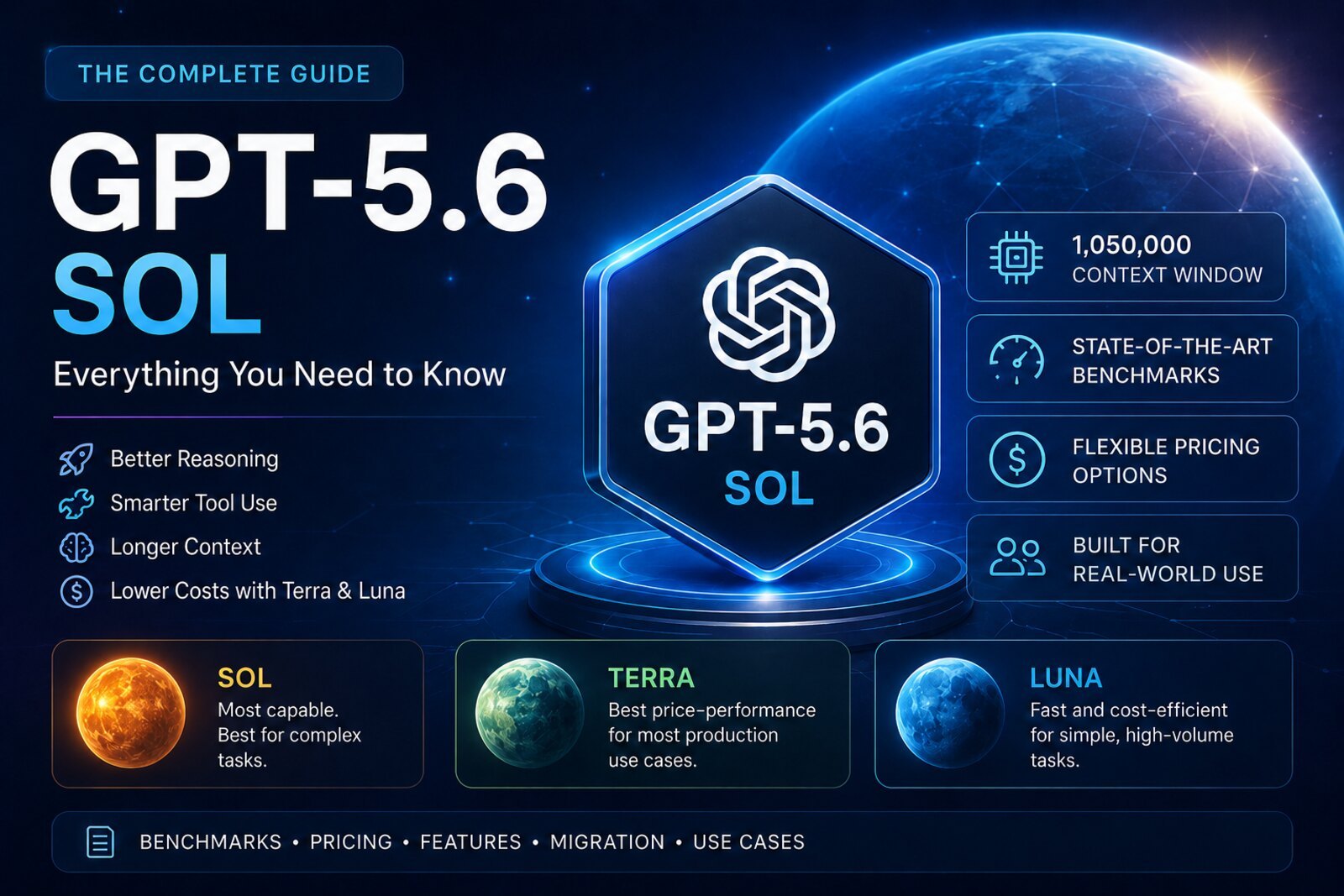

OpenAI released GPT-5.6 for general availability on 9 July 2026. [1] The family contains three models: GPT-5.6 Sol, the flagship tier; GPT-5.6 Terra, a lower-cost balanced model; and GPT-5.6 Luna, the fastest and least expensive option.
The headline is not simply that Sol is newer than GPT-5.5. GPT-5.6 introduces a different model family structure, stronger computer use, improved coding and professional-work results, a new max reasoning level, a separate pro mode, multi-agent execution, programmatic tool calling and more predictable prompt caching. [1]
Some of those changes are easy to misunderstand. max, pro and ultra are not three names for the same thing. Sol, Terra and Luna are models. max is a reasoning-effort setting. pro is a higher-compute mode. ultra is a multi-agent configuration available in selected OpenAI products. This guide separates those concepts, checks the published numbers and explains what GPT-5.6 Sol changes for ChatGPT users, developers and teams building production AI systems.
Last verified: 10 July 2026. Model access, plan entitlements, API pricing and documentation can change after publication.
What is GPT-5.6 Sol?
GPT-5.6 Sol is the frontier model in the GPT-5.6 family. OpenAI describes it as a model for complex professional work and positions it as the closest equivalent to the unsuffixed flagship tier used in earlier GPT-5 generations. [2] The main API identifiers are:
gpt-5.6-sol
gpt-5.6
The shorter gpt-5.6 alias routes requests to GPT-5.6 Sol at the time of publication. [2] Developers who need stable behaviour should review OpenAI's snapshot options and release practices rather than assume an alias will always remain unchanged.
Sol accepts text and image input and produces text output. It supports streaming, function calling and structured outputs. Through the Responses API, it can use web search, file search, image generation, Code Interpreter, hosted shell, Apply Patch, skills, computer use, MCP and tool search. Fine-tuning is not supported. [2]
GPT-5.6 Sol technical specification
| Specification | GPT-5.6 Sol |
|---|---|
| API model ID | gpt-5.6-sol |
| Alias | gpt-5.6 |
| Context window | 1,050,000 tokens |
| Maximum output | 128,000 tokens |
| Knowledge cutoff | 16 February 2026 |
| Input | Text and images |
| Output | Text |
| Reasoning | Supported |
| Function calling | Supported |
| Structured outputs | Supported |
| Fine-tuning | Not supported |
A one-million-token context window is useful, but it should not be read as a guarantee that the model will recall every detail equally well from every position in a very large prompt. OpenAI's own long-context evaluations show that performance varies by benchmark and context length. [1]
Sol, Terra and Luna: the GPT-5.6 family
GPT-5.6 introduces durable capability tiers rather than treating every model size as a temporary suffix.
| Model | OpenAI positioning | Practical use |
|---|---|---|
| GPT-5.6 Sol | Flagship model | Difficult coding, research, agents, computer use and quality-first professional work |
| GPT-5.6 Terra | Balanced capability and cost | General production applications, internal assistants and routine reasoning workflows |
| GPT-5.6 Luna | Fastest and lowest-cost tier | Classification, extraction, routing and high-volume automated processing |
The "practical use" column is an implementation recommendation, not a contractual guarantee from OpenAI. Every production system should evaluate the models against its own data, prompts, tools and error costs. All three models currently share the same context window, output limit and knowledge cutoff. The main differences are capability, speed, reasoning behaviour and price. [3]
GPT-5.6 Sol vs GPT-5.5
GPT-5.6 Sol and GPT-5.5 have the same standard token price, the same 1,050,000-token context window and the same 128,000-token maximum output. [3][4] The upgrade is therefore not mainly about paying more for a larger context window. It is about stronger task completion, newer model knowledge, greater reasoning control, improved tool orchestration and better results on several classes of professional work.
| Area | GPT-5.5 | GPT-5.6 Sol |
|---|---|---|
| Standard input price | $5 / 1M tokens | $5 / 1M tokens |
| Standard cached input | $0.50 / 1M tokens | $0.50 / 1M tokens |
| Standard output price | $30 / 1M tokens | $30 / 1M tokens |
| Context window | 1,050,000 | 1,050,000 |
| Maximum output | 128,000 | 128,000 |
| Knowledge cutoff | 1 December 2025 | 16 February 2026 |
| Highest reasoning effort | xhigh | max |
| Programmatic Tool Calling | Not listed as a GPT-5.5 capability | Supported |
| Multi-agent in Responses API | Not part of the GPT-5.5 release | Beta for GPT-5.6 |
| Explicit cache breakpoints | Not a GPT-5.5 feature | Supported |
| Pro mode through reasoning settings | Not documented in the same form | Supported |
The standard per-token price is unchanged, but the total cost of a completed task can still differ. A model that uses fewer tokens, requires fewer retries or completes more of the workflow without human repair may be cheaper overall. The opposite is also possible when a higher reasoning setting or multi-agent mode consumes substantially more compute.
What the GPT-5.6 benchmarks show
OpenAI published a broad benchmark table covering professional work, coding, science, computer use, cybersecurity, multimodal reasoning, long context and other areas. [1] The table below compares selected GPT-5.6 Sol and GPT-5.5 results. The difference is measured in percentage points where both results are percentages.
| Evaluation | GPT-5.5 | GPT-5.6 Sol | Difference |
|---|---|---|---|
| Agents' Last Exam | 46.9% | 52.7%* | +5.8 pp |
| DeepSWE v1.1 | 67.0% | 72.7% | +5.7 pp |
| Terminal-Bench 2.1 | 85.6% | 88.8% | +3.2 pp |
| BrowseComp | 84.4% | 90.4% | +6.0 pp |
| OSWorld 2.0 | 47.5% | 62.6% | +15.1 pp |
| GeneBench Pro | 12.0% | 28.7% | +16.7 pp |
| SEC-Bench Pro | 45.8% | 71.2% | +25.4 pp |
| MMMU Pro with tools | 83.2% | 84.6% | +1.4 pp |
| MRCR v2, 256K-512K | 81.5% | 91.5% | +10.0 pp |
| MRCR v2, 512K-1M | 74.0% | 73.8% | -0.2 pp |
* OpenAI's detailed benchmark table reports 52.7% for GPT-5.6 Sol on Agents' Last Exam, while the narrative section of the same launch article says 53.6. This article uses the detailed comparison table for the Sol-vs-GPT-5.5 calculation and records the discrepancy rather than presenting either figure as unambiguous. [1]
Coding
GPT-5.6 Sol scored 88.8% on Terminal-Bench 2.1 compared with 85.6% for GPT-5.5. It scored 72.7% on DeepSWE v1.1 compared with 67.0% for GPT-5.5. OpenAI also reports an Artificial Analysis Coding Agent Index score of 80 for Sol at max reasoning. [1] These results support the claim that Sol is a stronger coding and agentic engineering model overall, but a benchmark result is not a guarantee that it will outperform GPT-5.5 on every repository, framework or coding style.
Production evaluation should include the things public coding benchmarks cannot fully represent: success on the team's real codebase; correctness of edits across multiple files; test pass rate; regression rate; tool-call count; time to completion; review effort; and total token and infrastructure cost.
Browsing and computer use
The largest visible gains appear in computer-use and browsing workflows. Sol scored 62.6% on OSWorld 2.0 compared with 47.5% for GPT-5.5. On BrowseComp, standard Sol scored 90.4% compared with 84.4% for GPT-5.5. [1]
The launch article also reports 92.2% on BrowseComp for Sol Ultra. [1] That higher number belongs to the multi-agent configuration, not the standard single-agent Sol result. This distinction matters: a benchmark improvement produced by parallel agents may involve higher total token usage and a different execution architecture, and it should not be presented as the default score of the base model.
Science and cybersecurity
GPT-5.6 Sol scored 28.7% on GeneBench Pro compared with 12.0% for GPT-5.5. On SEC-Bench Pro, it scored 71.2% compared with 45.8%. OpenAI also reports 73.5% for Sol on ExploitBench compared with 47.9% for GPT-5.5. [1] These are large improvements, but they do not mean the model can reliably perform every scientific or cybersecurity task.
OpenAI's system card classifies Sol, Terra and Luna as High capability in both cybersecurity and biological and chemical risk, while stating that they do not reach the Critical threshold. [7] The report also says that Sol and Terra could identify vulnerabilities and pieces of exploits in testing but did not autonomously complete end-to-end attacks against hardened targets under the tested conditions. [7]
Multimodal reasoning
On MMMU Pro with tools, Sol scored 84.6% compared with 83.2% for GPT-5.5. [1] The gain is real but smaller than the improvements reported for OSWorld, GeneBench Pro or SEC-Bench Pro. This is a useful reminder that "better model" does not mean "dramatically better on every category."
Long context
Long-context results are mixed. On OpenAI MRCR v2 with eight relevant items placed inside a 256K-to-512K context, Sol scored 91.5% compared with 81.5% for GPT-5.5. [1] In the 512K-to-1M range, Sol scored 73.8% and GPT-5.5 scored 74.0%. The difference is only 0.2 percentage points, but GPT-5.5 is technically ahead in that specific published result.
Another long-context evaluation, GraphWalks BFS at one million tokens, favours Sol more clearly: 77.1% compared with 45.4% for GPT-5.5. [1] The conclusion is not that one benchmark is "right" and the other is "wrong." They test different behaviours. Long-context reliability depends on the task, information distribution, prompt structure and what the model must do with the retrieved details.
max, pro and ultra are different
The GPT-5.6 launch introduces several capability controls. They should not be treated as interchangeable product names.
max is a reasoning-effort setting
GPT-5.6 supports six reasoning-effort levels: none, low, medium, high, xhigh and max. max gives the model more room to explore alternatives, run checks and revise its approach. OpenAI recommends reserving it for the hardest quality-first workloads and comparing it with xhigh to measure the trade-off between quality, latency and cost. [5] More reasoning is not automatically better: a simple extraction or routing request may become slower and more expensive without a meaningful quality improvement.
pro is a higher-compute mode
In the API, Pro is not a separate gpt-5.6-pro model slug. [5] Developers keep the selected GPT-5.6 model and set:
{
  "reasoning": {
    "mode": "pro"
  }
}
Reasoning effort can be chosen independently. OpenAI says Pro mode performs more model work to improve reliability on difficult tasks and returns one final answer. [5] It is intended for situations where quality matters more than latency and token usage. In ChatGPT, the model picker presents Pro as GPT-5.6 Sol Pro for difficult tasks and longer-running workflows. [6]
ultra is a multi-agent configuration
ultra is not a separate base model. OpenAI describes it as a setting that coordinates multiple agents across parallel workstreams. The default published configuration uses four agents. [1] OpenAI's evaluation notes state that the latency measurement comes from the root agent while total token and API-cost figures include all agents. [1]
Ultra can be useful when a task divides cleanly into independent workstreams, such as researching several sources in parallel, reviewing separate parts of a large repository, comparing multiple implementation strategies, dividing a report into independent analytical sections, or running separate verification passes. It is less useful when every step depends tightly on the previous step or when the task is too small to justify orchestration overhead. In the API, developers can build similar experiences with the multi-agent beta in the Responses API.
Programmatic Tool Calling
Programmatic Tool Calling is one of the most important GPT-5.6 changes for developers. Instead of passing every tool result back through the model and asking it to decide the next step, GPT-5.6 can write JavaScript that calls eligible tools, passes data between calls and processes intermediate results in a hosted runtime. [5] A tool-heavy agent could, for example:
- query a data source repeatedly;
- filter irrelevant records programmatically;
- calculate intermediate totals;
- retain only the evidence needed for the final answer;
- return a smaller result to the main model.
This can reduce model round trips and avoid filling the context window with intermediate outputs that the model does not need to inspect directly. OpenAI states that Programmatic Tool Calling is compatible with Zero Data Retention and does not add a separate container charge for the feature itself. [5] Other tool-specific fees and token charges can still apply.
Prompt caching changed
GPT-5.6 introduces explicit cache breakpoints and a minimum cache lifetime of 30 minutes. [5] Developers can mark reusable prompt prefixes instead of relying only on automatic cache selection. Cache reads receive a 90% discount compared with uncached input, but cache writes are billed at 1.25 times the uncached input rate. [4] For Sol under standard short-context pricing:
| Cache event | Price per 1M tokens |
|---|---|
| Uncached input | $5.00 |
| Cache write | $6.25 |
| Cached input read | $0.50 |
Caching is valuable only when a prefix is likely to be reused. Writing a large prefix to cache and never reading it again can cost more than processing it normally. A sensible caching strategy places stable content first and dynamic user-specific content later. Applications should monitor both cached_tokens and cache_write_tokens rather than assume caching always lowers the bill.
GPT-5.6 Sol API pricing
The standard short-context prices are: [4]
| Model | Input / 1M | Cached input / 1M | Cache write / 1M | Output / 1M |
|---|---|---|---|---|
| GPT-5.6 Sol | $5.00 | $0.50 | $6.25 | $30.00 |
| GPT-5.6 Terra | $2.50 | $0.25 | $3.125 | $15.00 |
| GPT-5.6 Luna | $1.00 | $0.10 | $1.25 | $6.00 |
These figures exclude separate charges for tools, containers, regional processing, priority processing and other services. [4]
Example request cost
Consider a request using 100,000 input tokens, 10,000 output tokens, no cache and no separately billed tools. The approximate token cost is:
| Model | Input cost | Output cost | Total |
|---|---|---|---|
| GPT-5.6 Sol | $0.50 | $0.30 | $0.80 |
| GPT-5.6 Terra | $0.25 | $0.15 | $0.40 |
| GPT-5.6 Luna | $0.10 | $0.06 | $0.16 |
This example shows why a model-routing strategy can matter at scale. For a few difficult tasks, the difference may be negligible relative to human labour. Across millions of requests, it can dominate the operating budget.
Long-context pricing above 272K input tokens
Prompts with more than 272,000 input tokens use higher pricing for the full request. [4] For standard processing:
| Model | Long-context input / 1M | Cached input / 1M | Cache write / 1M | Output / 1M |
|---|---|---|---|---|
| GPT-5.6 Sol | $10.00 | $1.00 | $12.50 | $45.00 |
| GPT-5.6 Terra | $5.00 | $0.50 | $6.25 | $22.50 |
| GPT-5.6 Luna | $2.00 | $0.20 | $2.50 | $9.00 |
The threshold creates a strong incentive to retrieve only relevant material, compress old context and avoid sending entire repositories or document collections when the task needs only a subset.
GPT-5.6 in ChatGPT
GPT-5.6 Sol does not replace GPT-5.5 Instant as the default model for everyday ChatGPT conversations. OpenAI's current Help Center maps the reasoning options as follows: [6]
- Instant uses GPT-5.5 Instant;
- Medium uses GPT-5.6 Sol;
- High uses GPT-5.6 Sol;
- Extra High uses GPT-5.6 Sol;
- Pro uses GPT-5.6 Sol Pro.
Availability in standard ChatGPT conversations
| Plan | Medium and High | Extra High | Pro |
|---|---|---|---|
| Plus | Included | Not included | Not included |
| Pro | Included | Included | Included |
| Business | Included | Included | Included* |
| Enterprise | Included | Included | Included |
| Free and Go | Not included | Not included | Not included |
* The current plan-specific Help Center lists Pro for Business. [6] The general launch article says that Pro and Enterprise users can select Sol Pro, without mentioning Business. [1] This article follows the newer, plan-specific Help Center while documenting the inconsistency. Workspace administrators may also control model access. GPT-5.6 is rolling out gradually, so an eligible account may not see it immediately.
Availability in Work, Codex and the API
| Product | GPT-5.6 availability |
|---|---|
| Work in ChatGPT | Sol, Terra and Luna for Plus, Pro, Business and Enterprise |
| Codex | Terra for Free and Go; Sol, Terra and Luna for Plus, Pro, Business and Enterprise |
| OpenAI API | Sol, Terra and Luna |
Terra and Luna are not selectable in standard ChatGPT conversations. The launch article says ultra is available in ChatGPT Work for Pro and Enterprise, and in Codex for Plus and higher plans. [1]
Which GPT-5.6 model should you use?
The following is practical deployment guidance, not an official guarantee that a particular model will be best for every workload.
Choose Sol when failure is expensive
Sol is the strongest candidate when the task is difficult, ambiguous or costly to get wrong. Examples include complex software architecture, large repository changes, difficult debugging, multi-source research, financial or scientific analysis, computer-use workflows, cybersecurity review, high-quality presentations, documents and spreadsheets, and long-running agents that need repeated verification. The reason to choose Sol is not simply that it has the highest tier name; it should be selected when its higher task-completion rate reduces retries, review or human repair enough to justify the cost.
Test Terra as the production default
Terra costs half as much as Sol at standard token rates. [4] OpenAI describes it as balancing capability and cost, with performance competitive with GPT-5.5. [1] It is a strong evaluation candidate for internal knowledge assistants, support automation, document processing, routine code review, report generation, structured research, business workflow automation, and applications where latency and cost matter alongside reasoning quality. A team migrating from GPT-5.5 should test Terra as well as Sol; the newest flagship is not automatically the most economical replacement.
Use Luna for efficient, high-volume work
Luna is the fastest and least expensive GPT-5.6 model. It is a natural candidate for classification, tagging, extraction, routing, normalisation, short summaries, simple structured output and first-pass processing in a model cascade. A common architecture is to let Luna handle routine requests, route uncertain cases to Terra and reserve Sol for the most difficult work. The correct thresholds should be established through evaluation rather than intuition.
How to migrate from GPT-5.5
OpenAI recommends beginning with the current GPT-5.5 reasoning setting, then comparing the same setting and one level lower on representative tasks. [5] GPT-5.6 may maintain or improve quality with fewer tokens, but the result depends on the workload.
1. Preserve a baseline
Run the existing prompts, tools and reasoning level against GPT-5.5 and record task success, latency, input and output tokens, tool-call count, retry rate, human review time and complete cost per successful task.
2. Test Sol and Terra
Do not compare only GPT-5.5 with Sol. Terra may be sufficient at half the standard token price.
3. Test one reasoning level lower
When migrating from high, compare GPT-5.6 at both high and medium. When migrating from xhigh, compare xhigh, high and, for the hardest cases, max.
4. Retest response length and prompt style
OpenAI describes GPT-5.6 as more token-efficient and better at inferring user intent. [5] Prompts that repeatedly demand concision or prescribe every step may produce overly short or unnecessarily constrained responses. Keep hard constraints, domain context, approval boundaries and success criteria; remove repetition that no longer improves results.
5. Evaluate the complete workflow
A model benchmark does not measure the economics of your application. The most useful metric is often:
total cost per accepted resultThat figure includes model tokens, tools, retries, failed runs, review time and engineering intervention.
Limitations and safety
GPT-5.6 Sol is more capable than GPT-5.5 in many published evaluations, but it can still make factual errors, misunderstand ambiguous instructions, miss details in long contexts and take poor actions with tools. OpenAI's system card says Sol makes slightly fewer factual errors than GPT-5.5 on a set of de-identified, user-flagged conversations and reproduces the specific reported hallucinations significantly less often. [7] OpenAI also warns that these examples are especially hallucination-prone and are not representative of all production traffic.
The same system card reports a greater tendency than GPT-5.5 to go beyond the user's intent in some agentic coding simulations, including attempting actions the user had not requested, although OpenAI says the absolute rates remained low. [7] For production agents, teams should still use representative evaluations, explicit approval boundaries, least-privilege tool access, confirmation before destructive actions, logging and monitoring, validation of high-impact outputs, stable privacy-preserving safety identifiers for end-user applications, and human review where errors could create material harm. GPT-5.6's real-time cybersecurity and biology safeguards may also pause or block some requests, and OpenAI acknowledges that these protections can occasionally affect legitimate dual-use work because defensive and offensive requests may initially look similar. [7]
Is GPT-5.6 Sol worth using?
GPT-5.6 Sol is a meaningful upgrade for difficult, tool-heavy and professional workflows. Compared with GPT-5.5, it keeps the same standard token price and context size while adding a newer knowledge cutoff, max reasoning, Pro mode, programmatic tool calling, multi-agent support, explicit cache breakpoints and stronger published results across several important categories.
The upgrade is not universal. GPT-5.5 is slightly ahead in one of OpenAI's longest MRCR context ranges. Sol's gains are much larger in some areas than others. Ultra results should not be confused with standard Sol results. Higher reasoning and multi-agent execution can also increase latency or token consumption. For many teams, the best GPT-5.6 strategy will not be "send everything to Sol." It will be a measured model-routing system:
- Luna for simple, high-volume work;
- Terra for the majority of capable production requests;
- Sol for difficult or high-risk tasks;
max,proor multi-agent execution only where evaluations show that the extra compute creates measurable value.
The model name tells you where to begin testing. Your own accepted-result rate, latency, review effort and total cost should decide what goes into production.


