

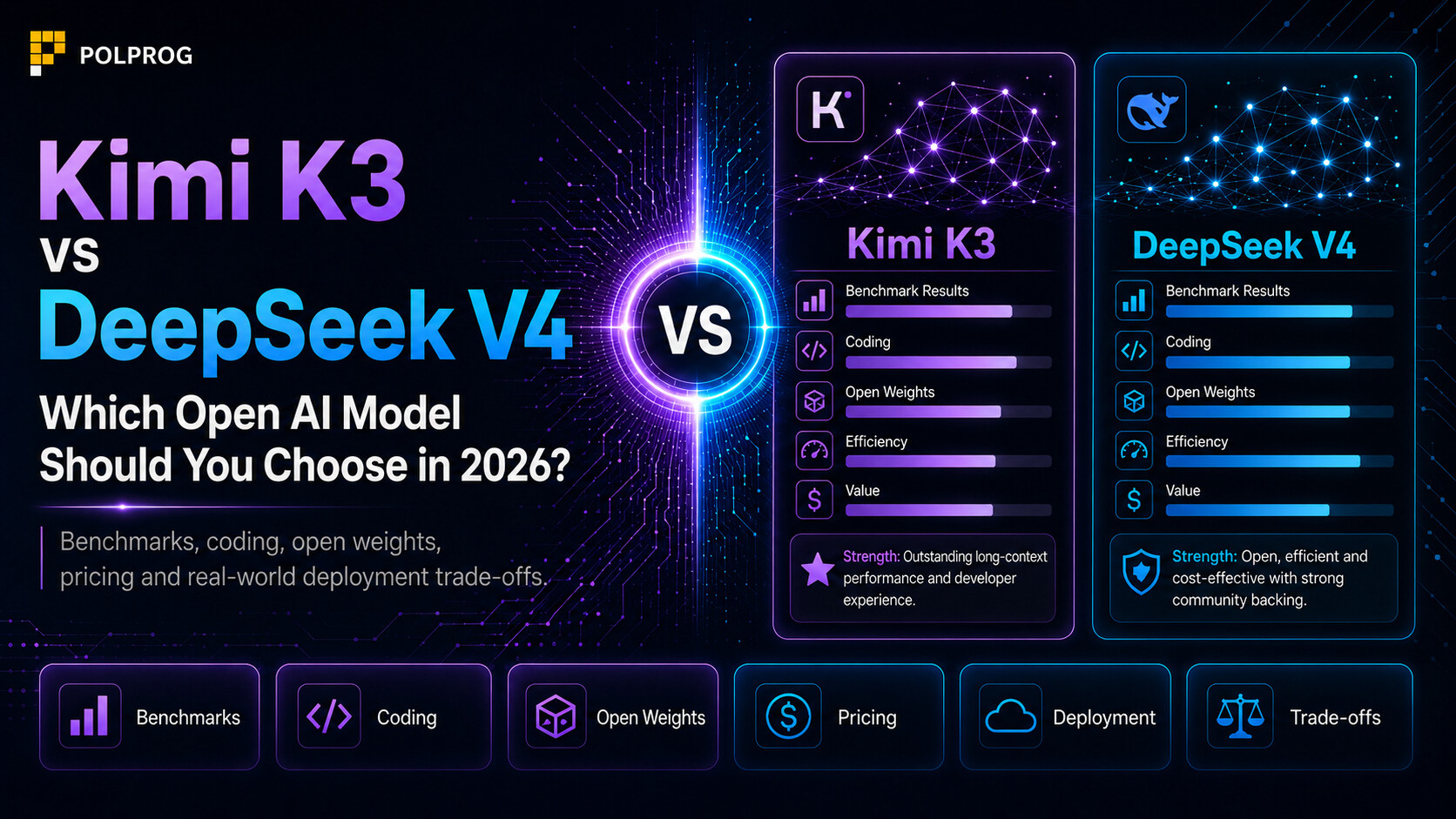

At first glance, Kimi K3 and DeepSeek V4 look like two similar Chinese AI models. Both offer a context window of roughly one million tokens, use Mixture-of-Experts architectures, target coding and agentic work, and are positioned as alternatives to proprietary models from US providers.
In practice, the differences are larger than the launch material suggests.
DeepSeek V4 is already available in two main variants: V4-Pro and V4-Flash. The weights of both models can be downloaded, and the MIT License permits commercial use. Kimi K3 is newer and clearly stronger in several independent evaluations, but at the time of the latest verification its complete weights had not yet been published. Moonshot AI said they would be released by July 27, 2026, while the final license had not yet been disclosed. [1][2][3]
That leads to the first and most important conclusion:
If you need a model with open weights that can be downloaded and deployed today, DeepSeek V4 wins without qualification. If you are using an API and care most about quality, multimodality and interface development, Kimi K3 is currently the stronger candidate.
Last verified: July 17, 2026. The status of Kimi K3's weights and license may change after the announced July 27 release.
First, an important correction: which model is actually open?
In the AI industry, the terms “open source,” “open model” and “open weights” are often used interchangeably even though they do not mean the same thing.
DeepSeek has released the model files for V4-Pro and V4-Flash under the MIT License. The license allows modification, deployment and commercial use, provided that the required license notices are retained. This does not make the complete training process transparent, but in practical deployment terms DeepSeek V4 is a model with genuinely available open weights today. [2][3]
Moonshot describes Kimi K3 as an open model in the roughly three-trillion-parameter class, but at the time of verification it could only be used through the company's products and API. The full weights and technical report were promised for a later date. Until the files and license are published, Kimi K3 should be described as a model with an announced open-weight release, not one that is ready for independent deployment. [1]
This distinction is not a semantic detail. It determines whether an organization can currently:
- download the model without the provider's permission;
- run it in its own infrastructure;
- freeze a specific version;
- fine-tune or quantize the weights;
- avoid future API price and policy changes;
- review the license before committing to a project.
Quick comparison
| Category | Kimi K3 | DeepSeek V4-Pro | DeepSeek V4-Flash |
|---|---|---|---|
| Developer | Moonshot AI | DeepSeek | DeepSeek |
| Release | July 14, 2026 | V4 family released April 24, 2026 | V4 family released April 24, 2026 |
| Total parameters | 2.8T | 1.6T | 284B |
| Active parameters | Not stated directly; 16 of 896 experts | Approx. 49B | Approx. 13B |
| Architecture | MoE, KDA, AttnRes, Stable LatentMoE | MoE, mixed FP4 and FP8 | MoE, mixed FP4 and FP8 |
| Context | 1M tokens | 1M tokens | 1M tokens |
| Maximum API output | 131,072 by default; higher configuration may be possible within limits | 384K tokens | 384K tokens |
| Text | Yes | Yes | Yes |
| Images | Yes | Not a native modality in the official model card | Not a native modality in the official model card |
| Video | Yes | No | No |
| Reasoning modes | Always on, currently max only | Non-reasoning, high, max | Non-reasoning, high, max |
| Uncached input price | $3 / 1M | $0.435 / 1M | $0.14 / 1M |
| Cached input price | $0.30 / 1M | $0.003625 / 1M | $0.0028 / 1M |
| Output price | $15 / 1M | $0.87 / 1M | $0.28 / 1M |
| OpenAI API compatibility | Yes | Yes | Yes |
| Anthropic API compatibility | No native provider layer documented | Yes | Yes |
| Open weights | Announced, not yet available | Yes | Yes |
| License | Not yet published | MIT | MIT |
| Best fit | Highest quality, images, video, frontend | Strong text model, agents, low-cost API, private deployment | High scale, routing, cheaper agents and self-hosting |
Architecture, modality, limit and pricing data come from official model cards and API documentation. [1][2][4][5]
What is Kimi K3?
Kimi K3 is Moonshot AI's latest flagship model. It has 2.8 trillion parameters and uses a sparse Mixture-of-Experts architecture. During generation, it activates 16 of 896 experts, which means it does not engage the entire network for every token. [1]
The model uses several technologies developed by Moonshot:
- Kimi Delta Attention, designed for efficient operation over very long sequences;
- Attention Residuals, which selectively retrieve representations from earlier layers;
- Stable LatentMoE, used to scale expert routing more reliably;
- training that accounts for low-precision weights and activations.
Moonshot says K3 delivers roughly 2.5 times the scaling efficiency of Kimi K2. This is a vendor claim rather than an independently confirmed result, particularly because the full technical report was not yet available. [1]
K3 is aimed primarily at long-running coding, research, work on large repositories, interface creation, game development and CAD projects. It accepts images and video natively, which distinguishes it from the text-only DeepSeek V4 family. [4]
What is DeepSeek V4?
DeepSeek V4 is not a single model but a family that includes at least two important variants.
DeepSeek V4-Pro
V4-Pro has 1.6 trillion parameters, with around 49 billion active during inference. It was trained on more than 32 trillion tokens and supports a one-million-token context window. DeepSeek positions it for difficult coding, reasoning, agents and tool use. [2][3]
V4-Pro is the appropriate Kimi K3 competitor when comparing the most capable model from each company.
DeepSeek V4-Flash
V4-Flash has 284 billion parameters, with approximately 13 billion active. It is weaker than V4-Pro, but far easier and cheaper to serve. It still offers a one-million-token context window, downloadable weights and the same MIT License. [2][3]
Flash may be more relevant than Pro for an ordinary company. It is suitable for routing simpler tasks, large-scale classification, extraction, less demanding code generation, and running many parallel agents without frontier-model economics.
What do independent benchmarks show?
The most useful current comparison comes from Artificial Analysis, which evaluates models with a consistent set of tests covering reasoning, knowledge, coding, terminal work and professional tasks.
| Metric | Kimi K3 | DeepSeek V4-Pro Max |
|---|---|---|
| Intelligence Index | 57 | 44 |
| Generation speed | 62.0 tokens/s | 61.1 tokens/s |
| Output tokens across the evaluation | Approx. 130M | Approx. 180M |
| Total evaluation cost | $2,690.80 | $176.34 |
| Context | 1M | 1M |
| Weight status at measurement time | Not publicly available | Open, MIT |
Kimi leads by 13 points on the aggregate index, which is a substantial difference. This is not a marginal variation in one benchmark: in the current independent suite, Kimi is clearly the stronger general model. [6][7]
DeepSeek answers with price. Completing the same class of evaluation cost about 15.3 times less, even though DeepSeek produced more output tokens. That illustrates just how aggressive its pricing is. [6][7]
It is also important that generation speed after the response begins was almost identical. DeepSeek did not achieve its cost advantage by reducing throughput by an order of magnitude. The larger differences concern quality and the number of tokens needed to complete a task. [6][7]
What do the Arena rankings show?
In Arena's text leaderboard snapshot from July 16, Kimi K3 had a preliminary score of around 1486 and was in the top ten. DeepSeek V4-Pro and its thinking variant were around 1456-1458 and ranked noticeably lower. Kimi's score was marked as preliminary and was based on fewer votes, so the position gap should not be treated as final. [8][8]
The WebDev Arena gap was larger. Kimi K3 was provisionally first with a score around 1679, while DeepSeek V4-Pro-thinking was much lower at around 1459. This leaderboard is particularly relevant to website and interface development because it evaluates visual outcomes rather than only the textual correctness of an answer. [9][9]
That result is consistent with model capabilities. Kimi can examine screenshots and iterate based on an image. DeepSeek V4 is a text model, so a similar workflow requires an additional visual description layer or an external vision model.
Coding: which model is better?
There is currently no single independent and perfectly controlled suite comparing Kimi K3 and DeepSeek V4 across all the same coding agent harnesses.
Moonshot reports, among other results, 67.5 on DeepSWE, 88.3 on Terminal-Bench 2.1, 81.2 on FrontierSWE and 42.0 on SWE Marathon for Kimi. DeepSeek reports 80.6 on SWE-bench Verified, 55.4 on SWE-bench Pro, 67.9 on Terminal-Bench 2.0 and 93.5 on LiveCodeBench for V4-Pro Max. These numbers must not be placed in a simplistic winner-loser table because they were obtained with different benchmark versions, agents, limits and methodologies. [1][2]
A safer conclusion follows from independent evaluations and the nature of the models.
Kimi K3 will usually be better when:
- the task involves frontend work or an interface evaluated from screenshots;
- the agent needs to analyze images or recordings;
- the highest quality of these two models is required;
- the model works on a difficult task for many hours;
- cost matters but is not the primary constraint;
- the company does not yet need a private deployment of the weights.
DeepSeek V4-Pro will usually be better when:
- the task is primarily textual and code-based;
- the budget requires many attempts;
- many agents need to operate in parallel;
- you want to use Claude Code without paying Anthropic model rates;
- you need to freeze and independently maintain a particular model version;
- you need non-reasoning mode for simple operations.
DeepSeek V4-Flash will usually be better when:
- throughput is the priority;
- you process large volumes of repetitive work;
- you are building an inexpensive layer of helper agents;
- you need a more realistic self-hosting option;
- you do not need Kimi or V4-Pro quality for every request.
Agents and tool use
DeepSeek V4 supports tool calling, JSON output, prefix completion and long responses of up to 384,000 tokens. The API offers non-reasoning mode, high and max. Its documentation notes that when using tools in thinking mode, an application must return reasoning_content in later requests; omitting it can produce an HTTP 400 error. [5]
DeepSeek also provides Anthropic API compatibility and an official guide for connecting V4 to Claude Code. The company maps model names and environment variables directly, while web search can operate in that environment through DeepSeek's API. [10]
Kimi also supports function calling, tool_choice, JSON Schema, dynamic tool loading, streaming and automatic caching. Like DeepSeek, however, it requires the complete reasoning-related assistant history to be preserved. Moonshot warns that dropping those messages or switching models during a session can reduce stability. [4][1]
At the time of verification, Kimi's official web-search feature was being updated and was not recommended for production. DeepSeek therefore had a more practical integration in this area, especially for Claude Code users. [4][10]
Reasoning controls
This part of the comparison clearly favors DeepSeek.
DeepSeek V4 can operate:
- without reasoning;
- with
reasoning_effort="high"; - with
reasoning_effort="max".
The documentation maintains compatibility with additional effort labels: low and medium map to high, while xhigh maps to max. For complex agent tasks such as Claude Code sessions, the API may automatically choose maximum effort. [5]
Kimi K3 has reasoning permanently enabled and, at launch, supported only:
reasoning_effort="max"Moonshot announced lower-effort modes, but they were not yet available. [4]
For a difficult problem, this is not necessarily a disadvantage. For simple transformations, classifications, short answers or high-volume routing, however, it causes unnecessary token consumption and prevents the workload from being matched to the value of the task.
Images, documents and video
Kimi K3 has an advantage that cannot be offset by token pricing alone: it is multimodal.
The official API accepts text, images and video files. The same model can therefore inspect code, review an application screenshot, identify differences from a design and then implement corrections. It can also work with video without requiring frames to be extracted manually and passed to a separate model. [4]
DeepSeek V4-Pro and V4-Flash are described as text models. A multimodal workflow can be built around them, but it requires an additional vision model, OCR, transcription or a custom extraction layer. [2][7]
For backend systems, scripts, repository analysis and terminal agents, that may not matter. For frontend work, visual QA, mobile applications, games and video analysis, it is one of the most important differences.
API pricing comparison
| Token type | Kimi K3 | DeepSeek V4-Pro | DeepSeek V4-Flash |
|---|---|---|---|
| Uncached input | $3.00 / 1M | $0.435 / 1M | $0.14 / 1M |
| Cached input | $0.30 / 1M | $0.003625 / 1M | $0.0028 / 1M |
| Output | $15.00 / 1M | $0.87 / 1M | $0.28 / 1M |
At official list prices, V4-Pro input is about 6.9 times cheaper than Kimi input, while output is about 17.2 times cheaper. Cached reads are about 82.8 times cheaper. V4-Flash widens the difference further. [5][11]
Example 1: repository task
Assumptions:
- 100,000 uncached input tokens;
- 10,000 output tokens.
| Model | Input | Output | Total |
|---|---|---|---|
| Kimi K3 | $0.30 | $0.15 | $0.45 |
| DeepSeek V4-Pro | $0.0435 | $0.0087 | $0.0522 |
| DeepSeek V4-Flash | $0.014 | $0.0028 | $0.0168 |
V4-Pro is about 8.6 times cheaper than Kimi in this example. Flash still costs less than four cents after several comparable attempts.
Example 2: large cached context
Assumptions:
- 500,000 cached input tokens;
- 20,000 output tokens.
| Model | Cached input | Output | Total |
|---|---|---|---|
| Kimi K3 | $0.15 | $0.30 | $0.45 |
| DeepSeek V4-Pro | $0.0018 | $0.0174 | about $0.0192 |
| DeepSeek V4-Flash | $0.0014 | $0.0056 | $0.0070 |
For a frequently repeated long prefix, the cost difference is enormous.
Model behavior still matters. In the Artificial Analysis evaluation, DeepSeek generated around 180 million output tokens, while Kimi generated around 130 million. DeepSeek was more verbose, but remained decisively cheaper. [6][7]
Self-hosting and hardware requirements
Open weights do not mean that the model will run on a powerful office workstation.
DeepSeek V4-Pro has 1.6 trillion total parameters even though roughly 49 billion are active during inference. The full weights, memory, expert routing, inter-device communication and cache for a one-million-token context require distributed infrastructure. The official model card includes serving instructions, but practical deployment of Pro remains a project for organizations with multiple accelerators. [2][3]
V4-Flash, with 284 billion total parameters and around 13 billion active, is a far more realistic private-infrastructure candidate. It is still not a laptop model, but its hardware cost and throughput should be easier to manage than V4-Pro.
Kimi K3 is larger still. Moonshot recommends supernode configurations with at least 64 accelerators. Even after the weights are released, private deployment will make sense mainly for hyperscalers, large laboratories and infrastructure providers. [1]
For most companies, “self-hosting” should therefore mean one of the following instead:
- using a specialist inference provider;
- renting a cluster for the duration of a workload;
- deploying the smaller V4-Flash;
- routing the hardest tasks to an external API.
Privacy and data location
A private deployment of DeepSeek V4 provides the greatest control over data, but only if the organization genuinely manages the infrastructure, logs, backups and administrator access.
When using the official API, DeepSeek's privacy policy states that the company collects prompts, files, images and conversation history, may use data to improve and train its technology, and processes personal data in the People's Republic of China. The policy also describes a way to object to training use. [12]
Kimi's platform privacy policy says that user content may be used to develop and improve its technology and that data is stored on secured servers in Singapore. Retention depends on factors including data type, account activity and legal obligations. [13]
No general privacy policy replaces an enterprise agreement. Before sending source code, trade secrets or customer data, an organization should obtain written terms covering:
- training use;
- opt-out options;
- retention and deletion;
- processing region;
- subprocessors;
- incident response;
- compliance with internal requirements.
Limitations of Kimi K3
Kimi's largest current weakness is that its announced openness cannot yet be verified. The final license, completeness of the release and terms for using the weights are not known.
The model also has three practical limitations:
- it currently operates only at maximum reasoning effort;
- it is sensitive to losing the complete reasoning-related message history;
- it can be excessively proactive and make unapproved decisions when instructions are ambiguous. [4][1]
Kimi is also much more expensive than DeepSeek, and its quality advantage is not necessary for every workload. Using it for simple parsing, classification or template-based code generation may be economically irrational.
Limitations of DeepSeek V4
DeepSeek V4-Pro is clearly weaker than Kimi K3 in the independent aggregate index. The gap was larger still on the WebDev leaderboard, and the absence of native image and video input limits it in visual workflows. [6][7][9][9]
The model is also very verbose. In the Artificial Analysis evaluation, it produced roughly 180 million output tokens, more than Kimi. Low prices mean it still remains inexpensive, but longer trajectories can increase latency, log volume and human review time. [7]
Agent integrations must preserve reasoning_content correctly. Incorrect history handling can interrupt a tool call. [5]
Open weights also do not automatically solve safety. An organization running the model itself assumes responsibility for tool isolation, updates, filters, monitoring, access control and data protection.
Which model should you choose?
Choose Kimi K3 when:
- you need the highest quality of the models compared here;
- you build frontends, applications, games or CAD tools;
- the agent must analyze screenshots or video;
- you use an API and do not yet need private weights;
- an individual task is valuable enough that model price is not dominant;
- you can test autonomous actions rigorously.
Choose DeepSeek V4-Pro when:
- you need genuinely available open weights;
- the MIT License and commercial use matter;
- you build text and coding agents at large scale;
- you want to reduce API cost radically;
- you plan to integrate with Claude Code or an Anthropic-format client;
- you need non-reasoning mode and greater control over effort;
- you accept lower overall quality than Kimi.
Choose DeepSeek V4-Flash when:
- price and throughput are the top priorities;
- you process large numbers of routine tasks;
- you are building a multi-model system;
- you need a more practical private-deployment option;
- difficult cases can be escalated to V4-Pro, Kimi or another model.
Consider routing across models
The most sensible architecture does not have to use one model for every task.
An example routing strategy:
- V4-Flash handles classification, extraction, simple corrections and helper agents;
- V4-Pro handles harder text and coding work;
- Kimi K3 takes over frontend, images, video and the most difficult cases;
- sensitive data remains on a private DeepSeek deployment;
- less sensitive work can use external APIs.
This approach uses Kimi's strengths without paying its rate for every request.
Verdict
The question in the title has two different answers.
The best open model that can be deployed today is DeepSeek V4. It has available weights, an MIT License, an extremely inexpensive API, a Pro variant for difficult tasks and a Flash variant for scale. It also offers mature OpenAI- and Anthropic-format compatibility, adjustable reasoning levels and an official Claude Code integration. [2][3][5][10]
The stronger model when used through an API is Kimi K3. It leads the independent Artificial Analysis Intelligence Index, performs better in current Arena rankings, supports images and video, and is particularly strong in visual interface development. [4][6][8][9]
Kimi may become an exceptionally interesting open-weight model after its release. An infrastructure decision should not, however, be based on an announcement alone. Teams should wait for the files, license, technical report and first independent deployment tests.
As of July 17, 2026, the recommendation is therefore straightforward:
- DeepSeek V4-Pro when you need private weights, low cost and a strong text model;
- DeepSeek V4-Flash when building an inexpensive system at scale;
- Kimi K3 when quality, frontend work, images and video matter more than full openness and price.
The best decision still comes from testing real workloads. A general benchmark will not show how a model handles a specific repository's conventions, a company's data formats, permission system or human-review costs.


