

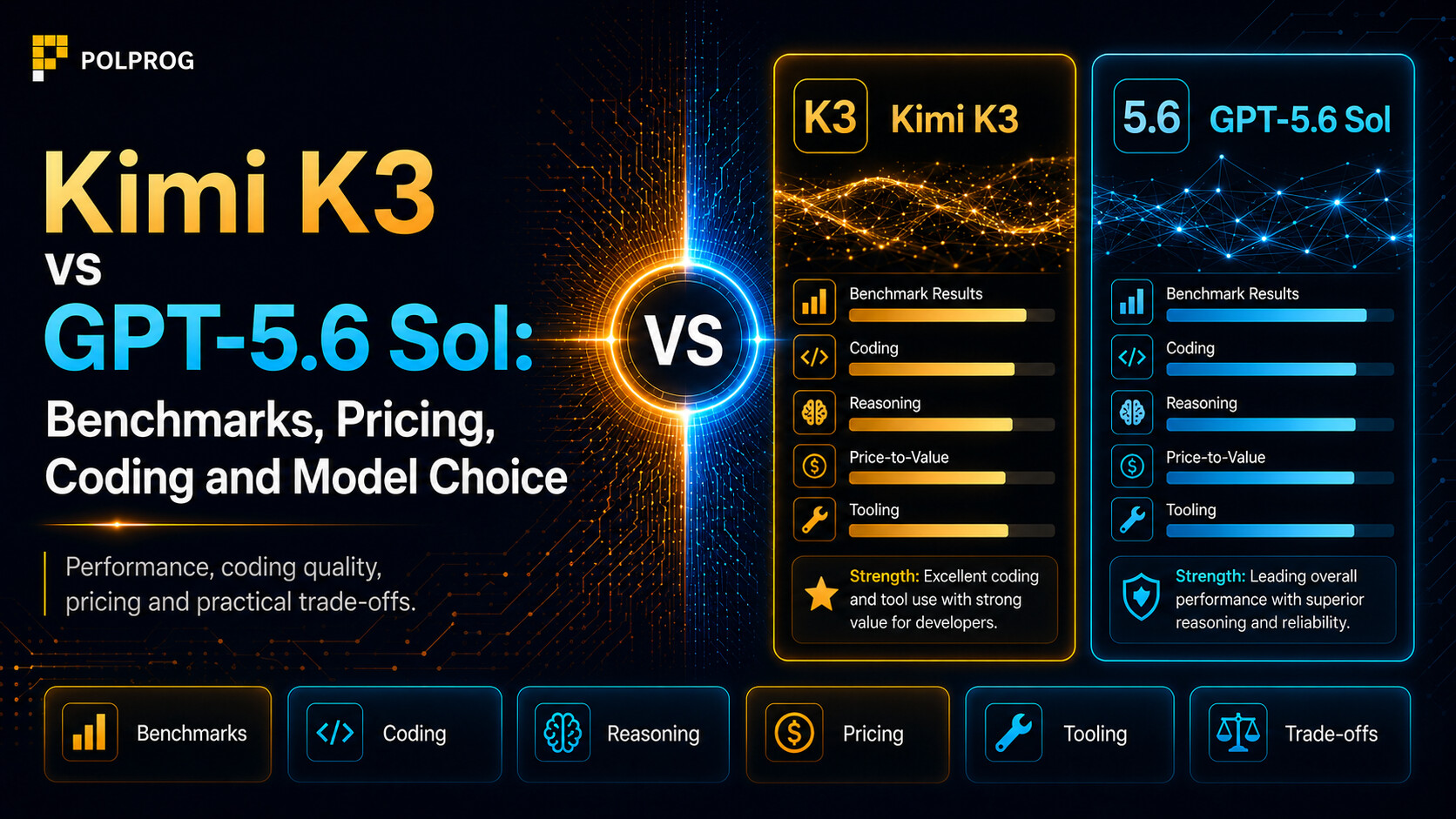

Kimi K3 and GPT-5.6 Sol represent two different directions in the development of the most advanced AI models.
OpenAI offers a closed, extensive ecosystem with broad reasoning controls, built-in tools and mature enterprise mechanisms. [4][6] Moonshot AI responds with a 2.8-trillion-parameter model, lower API pricing, native image and video understanding, and a promise to release the full weights. [1]
In published benchmarks, Kimi K3 can outperform GPT-5.6 Sol in some coding, agentic and document-analysis tasks. Sol still leads in the overall intelligence index, selected reasoning tasks and some tests of professional knowledge work.
The key conclusion is straightforward: Kimi K3 has not beaten GPT-5.6 Sol in every use case, but it is the first Moonshot AI model to become a genuine production alternative, especially where price, long-running tasks and infrastructure flexibility matter.
Last verified: 17 July 2026. Kimi K3 is a very new model. Its weights, licence, reasoning modes, prices and independent benchmark results may change in the coming weeks.
Quick comparison
| Category | Kimi K3 | GPT-5.6 Sol |
|---|---|---|
| Developer | Moonshot AI | OpenAI |
| API identifier | kimi-k3 | gpt-5.6-sol |
| Release date | 14 July 2026 | 9 July 2026 |
| Parameters | 2.8T | Undisclosed |
| Architecture | MoE, KDA, AttnRes | Undisclosed |
| Active experts | 16 of 896 | Undisclosed |
| Context window | 1M tokens | 1.05M tokens |
| Default response limit | 131,072 tokens | 128,000 tokens |
| Text input | Yes | Yes |
| Image input | Yes | Yes |
| Video input | Yes | No |
| Output | Text | Text |
| Reasoning | Always enabled, currently max | none, low, medium, high, xhigh, max |
| Input price | $3 / 1M | $5 / 1M |
| Cached input price | $0.30 / 1M | $0.50 / 1M |
| Output price | $15 / 1M | $30 / 1M |
| Long-context pricing | No additional threshold | Up to $10 input and $45 output |
| Function calling | Yes | Yes |
| Structured Outputs | Yes | Yes |
| Built-in tools | Limited, search tool being updated | Web search, file search, computer use |
| OpenAI API-compatible format | Yes | Native |
| Public weights | Announced, not yet available | No |
| Self-hosting | Planned, but very expensive | No |
The Kimi K3 specification comes from Moonshot AI documentation. The model offers a one-million-token context window, image and video understanding, automatic caching and an OpenAI-compatible API format. [2] GPT-5.6 Sol documentation lists a 1.05-million-token window, a maximum output of 128,000 tokens and a knowledge cutoff of 16 February 2026. [4]
What is Kimi K3?
Kimi K3 is Moonshot AI's latest flagship model. It has 2.8 trillion parameters and uses a Mixture of Experts architecture. During a single pass, the model activates 16 of the 896 available experts, so it does not need to use all parameters for every generated token. [1]
The model uses two important technologies developed by Moonshot AI:
Kimi Delta Attention, a hybrid attention mechanism designed for long sequences, and Attention Residuals, which allow the model to selectively retrieve representations from earlier layers instead of only adding them together. [1]
Moonshot claims roughly a 2.5-fold improvement in scaling efficiency compared with Kimi K2. [1] This is a vendor-reported result, however, and the full technical report covering K3 training and architecture has not yet been published.
K3 was designed primarily for:
- long-running agentic coding,
- working with large repositories,
- document and data analysis,
- tool-assisted research,
- creating interfaces, presentations and visualisations,
- understanding images and video material.
The model is already available in the Kimi app, Kimi Work, Kimi Code and through the official API. [1][2]
Is Kimi K3 really open source?
Moonshot AI describes Kimi K3 as the first open model in the roughly three-trillion-parameter class. [1] However, the promise of openness must be separated from the current distribution status.
According to Moonshot AI, the full weights are due to be released by 27 July 2026. [1] At the time of the last verification, on 17 July, they could not yet be downloaded or run independently. For this reason, Artificial Analysis classified Kimi K3 as proprietary because public weights were unavailable. [8]
A final assessment of its openness should therefore wait for:
- publication of the model files,
- disclosure of the full licence,
- release of inference code,
- a description of hardware requirements,
- a technical report on training and evaluation.
Even after the weights are released, self-hosting K3 will not be simple. Moonshot recommends supernode-style configurations with at least 64 accelerators. [2] The model may be technically open, but for most companies the API will remain more economical than running it in their own data centre.
What is GPT-5.6 Sol?
GPT-5.6 Sol is the flagship model in the GPT-5.6 family and the default target of the gpt-5.6 alias. [6] OpenAI positions it as a model for complex professional work, coding, research, cybersecurity and agentic workflows. [4]
The model supports:
- text and images as input,
- a 1.05-million-token context window,
- up to 128,000 output tokens,
- function calling,
- web search,
- file search,
- computer use,
- programmatic tool calling,
- preserving reasoning context between requests,
- multi-agent task execution in beta. [4]
OpenAI does not disclose Sol's architecture or parameter count. [4] The model cannot be run locally and is available only through OpenAI products and infrastructure.
What do independent benchmarks say?
Vendor-published benchmarks are useful, but they should not be the only basis for comparison. A provider can select settings, an agent framework, time limits and scoring methods that favour its own model.
That is why the Artificial Analysis Intelligence Index is especially relevant. It combines nine evaluations covering terminal coding, science, reasoning, knowledge and professional work, among other areas. [8][9]
In that evaluation:
| Model | Intelligence Index | Generation speed | Output tokens across the full test |
|---|---|---|---|
GPT-5.6 Sol max | 59 | 53.5 tokens/s | 70M |
| Kimi K3 | 57 | 62 tokens/s | 130M |
Sol leads by two points in the overall index, but Kimi generates output faster once streaming begins. [8][9] At the same time, K3 used almost twice as many output tokens throughout the test. [8]
This is an important economic consideration. Although a Kimi output token costs half as much as a Sol output token, completing the full Intelligence Index cost:
The actual difference was therefore only about 4.7%, because Kimi was substantially more verbose. This means that pricing per million tokens alone is not enough to estimate the cost of a task. You also need to measure how many tokens the model requires to reach a correct result.
Vals Index
In the Vals Index, which is based on private finance and programming tasks, Kimi K3 scored 74.7%, while GPT-5.6 Sol scored 73.1%. [10] The difference is small, but Kimi placed ahead of the OpenAI model in this particular test set.
This is not proof that Kimi is generally better. It does show, however, that its position among top-tier models is not based solely on benchmarks prepared by Moonshot AI.
Coding: which model is better?
There is no single coding benchmark that answers every question. Fixing a bug in a repository, building an application from scratch, optimising a GPU kernel and operating a terminal require different capabilities.
In the table published by Moonshot AI, the results for Kimi K3 and Sol were split: [1]
| Benchmark | Kimi K3 | GPT-5.6 Sol | Leader |
|---|---|---|---|
| DeepSWE | 67.5 | 73.0 | Sol |
| ProgramBench | 77.8 | 77.6 | Practical tie |
| Terminal-Bench 2.1 | 88.3 | 88.8 | Sol |
| FrontierSWE | 81.2 | 71.3 | Kimi |
| SWE Marathon | 42.0 | 39.0 | Kimi |
| PostTrain Bench | 36.6 | 34.6 | Kimi |
| MLS Bench | 48.3 | 46.2 | Kimi |
Kimi held a clear lead in FrontierSWE and achieved better results in several long-running tasks. Sol scored higher in DeepSWE and narrowly won Terminal-Bench. [1]
Caution is still necessary. Moonshot used different agent frameworks: Kimi Code, Claude Code and Codex. [1] Differences in tools, context management and command execution can have a major effect on the final result. The company itself describes these differences in detail in the table footnotes.
Kimi K3 will be a good choice when:
- an agent needs to work for many hours,
- the task involves a large repository,
- the model must iterate based on screenshots,
- you are building a frontend, game, CAD tool or an application with visual elements,
- the cost of repeated attempts matters,
- you want to use Kimi through OpenAI-compatible tools.
GPT-5.6 Sol will be the safer choice when:
- you need more predictable overall quality,
- the workflow uses Codex,
- the model must combine coding with search, files and computer use,
- you want precise control over reasoning effort,
- you require mature agent and data-management mechanisms.
Reasoning and knowledge work
In tests published by Moonshot AI, GPT-5.6 Sol led in several classic reasoning tasks: [1]
| Benchmark | Kimi K3 | GPT-5.6 Sol |
|---|---|---|
| GPQA Diamond | 93.5 | 94.1 |
| Humanity's Last Exam | 43.5 | 44.5 |
| Humanity's Last Exam with tools | 56.0 | 58.0 |
| GDPval-AA v2, Elo | 1668 | 1748 |
| Toolathlon-Verified | 73.2 | 74.9 |
Kimi led in BrowseComp, AutomationBench, Job Bench, AA-Briefcase and some office-work tasks. [1] The results suggest that K3 is very strong at executing complex workflows, while Sol retains a small advantage in some reasoning tests and professional output evaluation.
The differences are small enough that, in production, the way a model fails may matter more than its average score. A model that scores one point higher in a benchmark may still be worse in a particular company workflow if it more often breaks formatting, ignores constraints or performs unauthorised actions.
Images, documents and video
Both models analyse text and images, but Kimi K3 supports a broader range of inputs in its standard API. Moonshot documentation shows support for images and video files uploaded to the platform. [2]
GPT-5.6 Sol accepts text and images, but its model card does not list direct video or audio input. [4] Video must first be processed, for example into frames, a transcript or a description.
The visual benchmark picture is mixed:
- Sol leads in MMMU-Pro, MathVision, BabyVision and PerceptionBench. [1]
- Kimi leads in OmniDocBench, WorldVQA, ZeroBench and some chart- and document-interpretation tests.
- Results obtained with Python do not always preserve the same ranking as results without tools.
Kimi may be especially attractive for documents, interfaces, video content and iterative design. Sol remains the stronger and more consistent model for general visual reasoning.
Context window and response length
GPT-5.6 Sol supports 1,050,000 context tokens and a maximum of 128,000 output tokens. [4]
Kimi K3 has a context window of about one million tokens. The default max_completion_tokens value is 131,072, but the documentation allows the parameter to be set as high as 1,048,576. [2] This does not mean that the model can always generate a one-million-token response: the input, history and output must fit within the total context limit.
In practice, a larger limit does not guarantee better performance with long material. It is worth testing:
- retrieval of information placed in different parts of the prompt,
- compliance with constraints after hundreds of thousands of tokens,
- retention of earlier tool results,
- resistance to conflicting instructions,
- quality after automatic context compression.
Reasoning control
This is one of the biggest differences between the models.
GPT-5.6 Sol allows the following settings: [6]
none
low
medium
high
xhigh
max
OpenAI also provides a pro mode that increases the amount of work performed by the model on difficult tasks. [6][7] As a result, the same integration can use fast responses without reasoning, a medium level for everyday work, and max or pro for quality-critical problems.
Kimi K3 keeps reasoning permanently enabled. At launch, the API supported only: [2]
reasoning_effort="max"Moonshot announced lower levels for future updates, but they were not yet available on the verification date.
This is acceptable for complex agents. For simple classification, short chat or bulk data processing, however, it means there is no way to limit reasoning time and token use. In such tasks, GPT-5.6 Terra or Luna may be a more appropriate price competitor to Kimi than Sol.
Tools and API integration
The Kimi API is compatible with the OpenAI format. In many applications, migration may be limited to changing the key, base URL and model identifier: [2]
from openai import OpenAI

client = OpenAI(
    api_key=os.environ["MOONSHOT_API_KEY"],
    base_url="https://api.moonshot.ai/v1",
)

response = client.chat.completions.create(
    model="kimi-k3",
    messages=[
        {"role": "user", "content": "Analyse this repository."}
    ],
)
Kimi supports function calling, tool_choice, JSON Schema, streaming, dynamic tool loading and automatic caching of long prefixes. Moonshot warns, however, that its official search tool is currently being updated and is not recommended for production use. [2]
GPT-5.6 Sol has a more extensive platform-tool set, including web search, file search, computer use and programmatic tool calling. It also offers an experimental multi-agent mode in the Responses API. [4][6]
Kimi is easy to connect to an existing application. Sol, however, provides a more complete layer for building an entire agent platform.
API pricing comparison
Standard rates
| Token type | Kimi K3 | GPT-5.6 Sol |
|---|---|---|
| Uncached input | $3 / 1M | $5 / 1M |
| Cached input | $0.30 / 1M | $0.50 / 1M |
| Cache write | No separate rate in K3 pricing | $6.25 / 1M |
| Output | $15 / 1M | $30 / 1M |
Kimi's input is 40% cheaper, cached reads are 40% cheaper and output is 50% cheaper. [3][5]
Long context
Kimi applies flat rates across the entire one-million-token window. [3]
For GPT-5.6 Sol, requests containing more than 272,000 input tokens are billed for the entire request at higher rates: [5]
| Token type | GPT-5.6 Sol above 272,000 input tokens |
|---|---|
| Input | $10 / 1M |
| Cached input | $1 / 1M |
| Cache write | $12.50 / 1M |
| Output | $45 / 1M |
With large repositories, many documents or a long agent history, Kimi's pricing advantage may therefore increase significantly.
Example costs
The following calculations do not include separately billed tools or other infrastructure costs.
Example 1: a typical agent task
Assumptions:
- 100,000 input tokens,
- 10,000 output tokens,
- no cache.
| Model | Input | Output | Total |
|---|---|---|---|
| Kimi K3 | $0.30 | $0.15 | $0.45 |
| GPT-5.6 Sol | $0.50 | $0.30 | $0.80 |
Kimi is about 43.8% cheaper in this example.
Example 2: the same prompt with caching
| Model | Cached input | Output | Total |
|---|---|---|---|
| Kimi K3 | $0.03 | $0.15 | $0.18 |
| GPT-5.6 Sol | $0.05 | $0.30 | $0.35 |
Kimi is about 48.6% cheaper.
Example 3: large context
Assumptions:
- 500,000 input tokens,
- 20,000 output tokens,
- no cache.
| Model | Input | Output | Total |
|---|---|---|---|
| Kimi K3 | $1.50 | $0.30 | $1.80 |
| GPT-5.6 Sol | $5.00 | $0.90 | $5.90 |
After the long-context threshold is crossed, Kimi is about 69.5% cheaper in this example.
The real result may be less favourable if Kimi generates more reasoning and answer tokens. The independent Artificial Analysis evaluation showed that K3 can be almost twice as verbose as Sol on a similar task set. [8]
Privacy and data retention
OpenAI documents store=false, encrypted reasoning items and Zero Data Retention for approved organisations in detail. The Responses API may store application state for 30 days by default, but in organisations with ZDR, the store parameter is forced to false. [12]
The Kimi OpenPlatform privacy policy states that account information, inputs and payment information may be retained while an account is active, and that data is stored on secured servers in Singapore. [11] Retention periods depend on the type of information, settings and legal requirements.
Based on public documentation, OpenAI currently offers more thoroughly described controls for deployments requiring ZDR, retention management and organisational compliance.
This does not automatically mean that Kimi is unsuitable for enterprises. It means that, before sending confidential data, a company should obtain specific terms from Moonshot AI covering:
- use of data for training,
- retention duration,
- processing location,
- data deletion,
- incident handling,
- subprocessors,
- a DPA.
Kimi K3 limitations
Moonshot AI openly lists three important model limitations. [2]
First, K3 is sensitive to reasoning history. If a framework does not pass the full previous assistant message, or if the model is switched in the middle of a session, quality may become unstable.
Second, the model can be overly proactive. With an ambiguous instruction, it may make a decision that the user did not approve. In agents with access to the file system, terminal or infrastructure, this requires explicit boundaries and approval stages.
Third, the vendor itself acknowledges that the user experience still falls short of GPT-5.6 Sol and Claude Fable 5. [1][2]
Another issue is how recent the release is. A complete technical report, full weights and long-term production-stability analyses have not yet been published.
GPT-5.6 Sol limitations
Sol's biggest limitation is cost, especially with large context and high reasoning effort.
The model remains fully closed. A company cannot control the weights, run the model in isolated infrastructure or guarantee long-term access to a specific snapshot without relying on OpenAI policy.
The max and pro modes can have high latency. In Artificial Analysis measurements, Sol at max needed an average of 145.61 seconds to produce the first token. [9] This is a result from a specific methodology, not a guaranteed latency for every request, but it illustrates the cost of maximum reasoning effort.
OpenAI also applies real-time safeguards in areas such as cybersecurity and biology. [4] These may stop or delay a response even for some legitimate dual-use tasks.
Which model should you choose?
Choose Kimi K3 when:
- API cost is the top priority,
- you process very long prompts,
- you build coding agents that work for many hours,
- you need video input,
- you want to preserve the option of hosting open weights in the future,
- you already have an OpenAI-compatible integration,
- you can accept a younger, less mature ecosystem,
- you control agent actions through a sandbox and approval steps.
Choose GPT-5.6 Sol when:
- you care about the highest and more consistent general quality,
- you want to control reasoning effort per request,
- you need web search, file search or computer use,
- you use the Responses API, Codex or the OpenAI ecosystem,
- you require detailed retention and ZDR documentation,
- production predictability matters more than price,
- the model must perform professional tasks across many domains.
Consider using both models when:
The most rational architecture may not be about selecting a single winner.
Kimi K3 can handle:
- first attempts,
- analysis of large repositories,
- long context,
- visual tasks,
- generation of multiple variants.
GPT-5.6 Sol can perform:
- final verification,
- more difficult cases,
- compliance checks against requirements,
- tasks that require OpenAI tools,
- operations on data covered by organisational controls.
Such routing makes it possible to use Kimi's lower price without giving up Sol's stronger capabilities.
Verdict
GPT-5.6 Sol remains the better general-purpose choice. It leads in the independent Artificial Analysis Intelligence Index, has a more mature tool ecosystem, gives users greater control over reasoning and provides more detailed enterprise documentation. [8][12]
Kimi K3, however, is much closer to Sol than the difference between an open model from China and OpenAI's flagship product might suggest. It wins some coding and agent benchmarks, supports video, offers flat pricing across a million-token context window and is clearly cheaper per token. [3]
Kimi's full value as an open model cannot yet be confirmed because the weights and technical report were not available on the verification date. Its verbosity, sensitivity to reasoning history and tendency to take overly autonomous action should not be ignored either.
GPT-5.6 Sol wins on maturity, controllability and general quality. Kimi K3 wins on pricing, long context, video input and potential openness.
For new projects, both models should be tested on real tasks. The difference between them is now small enough that a general benchmark score should not replace an evaluation conducted on the company's actual data.


